




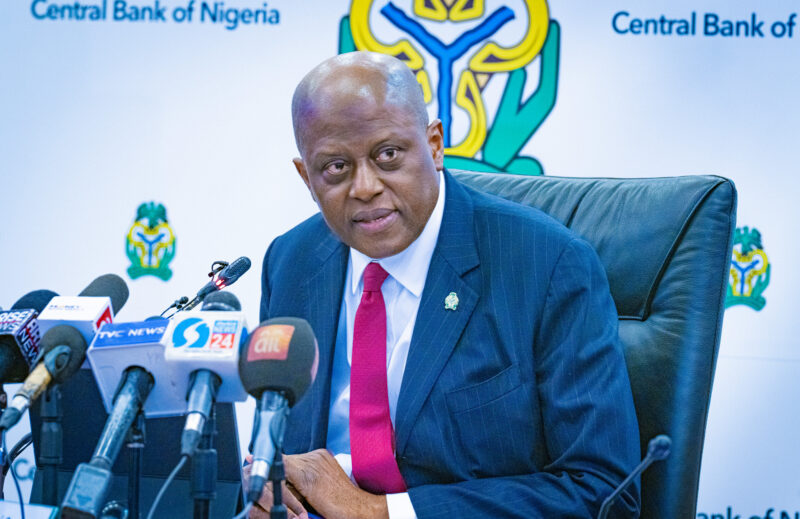
The Central Bank of Nigeria (CBN) is set to waive fees on transactions below ₦5,000 ($3.68) and reduce charges on mid-tier payments to encourage cashless payments.
According to a circular from the CBN to all banks and financial institutions dated April 21, 2026, inter-bank transfers between ₦5,000 ($3.68) and ₦50,000 ($36.81) will now cost ₦10 ($0.007), a significant 80% reduction from its previous ₦50 charge.
Fees for transfers above ₦50,000 ($36.81) remain at ₦50 ($0.037).
The changes mark one of the most significant pricing shifts in Nigeria’s payments space in six years, effectively lowering the cost of sending money for millions of users who rely on small, frequent transactions.
By removing fees on small transfers and compressing charges on mid-range transactions, the CBN hopes to encourage the further adoption of cashless payment options by small businesses.
According to statistics, In 2024, electronic payments in Nigeria crossed the ₦1 quadrillion ($736.14 billion) mark. According to Moniepoint’s 2025 Informal Economy Report, only one in four informal businesses reported that digital payments accounted for at least 10% of their total revenue in 2025.
Although the new pricing regime seeks to reduce the overall cost of transactions, transfers above ₦10,000 ($7.36) will still be priced at least ₦60 ($0.044).
Five years after replacing stamp duty with the Electronic Money Transfer Levy (EMTL), Nigeria reintroduced stamp duties in 2026. Introduced in 2020, EMTL imposed a flat, one-off ₦50 charge on electronic transfers of ₦10,000 ($7.36) and above, paid by the receiver.
From 2026, the ₦50 ($0.037) levy is no longer deducted from the receiver but from the sender, which has increased transfer costs.
For banks and fintechs, the CBN’s new transfer fee policy could reshape revenue expectations. In the first nine months of 2025, eight of Nigeria’s largest banks earned ₦514.82 billion ($378.98 million) from electronic payments.
For the government, however, little changes. Stamp duty, like the EMTL before it, remains a small but growing source of revenue, with collections rising to ₦392.78 billion ($289.14 million) in the first 11 months of 2025.
For users, sending small amounts is now cheaper, or free, but transfers above ₦10,000 may feel more expensive once the levy is applied, even as PoS withdrawal fees become more predictable.