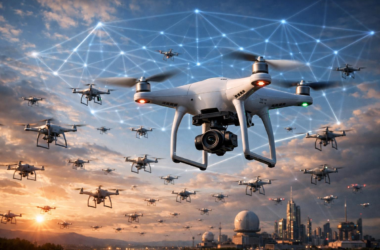





Artificial intelligence is automating repetitive tasks, reshaping entire roles, and quietly creating new opportunities. The real story is less about replacement and more about transformation.
For most people, the conversation around AI and jobs has started to feel unsettling.
Every new update seems to raise the same question: will artificial intelligence take over my work?
It’s a valid concern. AI is already writing emails, generating reports, summarizing documents, and even assisting with coding and design tasks. From the outside, it can look like a system that is steadily absorbing human work.
But that interpretation misses something important.
The real shift is not that AI is replacing entire jobs overnight. It’s that it is breaking jobs down into tasks—and changing which parts of work humans spend time on.
AI Is Replacing Tasks, Not Entire Jobs
Most jobs are not single activities. They are collections of smaller tasks performed together.
Some of those tasks are repetitive and predictable. Others require judgment, creativity, or human interaction.
AI is particularly good at the first category.
Today, it can already handle:
* Drafting basic content and reports
* Summarizing long documents
* Processing and organizing data
* Translating text
* Writing simple code
* Handling basic customer support queries
* Scheduling and administrative coordination
These are not futuristic capabilities. They are already being used in workplaces today.
However, the parts of work that involve context, responsibility, and human judgment are far more difficult to automate.
Things like:
* Making strategic decisions
* Understanding complex real-world situations
* Negotiating and communicating with people
* Leading teams
* Building trust with clients or customers
* Taking accountability for outcomes
This is why, in most cases, AI does not remove the job entirely. It removes or reduces specific tasks within it.
Which Jobs Are Feeling the Most Change
Some roles are experiencing faster disruption than others, especially those heavily built around routine digital tasks.
These include:
* Administrative support roles
* Entry-level content writing and editing
* Customer service and support centers
* Basic data analysis and processing
* Translation and transcription work
* Entry-level software development tasks
In many of these fields, the work is not disappearing completely. Instead, the expectations are shifting.
For example, a customer support agent may now handle fewer repetitive queries and focus more on complex cases. A writer may spend less time drafting from scratch and more time refining and shaping ideas. A developer may focus less on boilerplate code and more on system design and problem-solving.
The nature of the work is changing, even if the job title stays the same.
The Jobs AI Is Quietly Creating
While much attention is placed on jobs being affected, less attention is given to the roles emerging around AI itself.
As organizations adopt artificial intelligence at scale, new categories of work are appearing:
* AI engineers and system developers
* AI product managers
* Machine learning operations specialists
* AI safety and evaluation researchers
* Data center and infrastructure technicians
* AI integration consultants for businesses
* Cybersecurity specialists focused on AI systems
* Workflow automation designers
* Data quality and model training specialists
Beyond entirely new roles, AI is also increasing the value of existing professions that learn how to use it effectively.
Lawyers, marketers, teachers, doctors, analysts, and journalists are not being replaced—but the most effective professionals in these fields are increasingly those who can use AI to enhance their work rather than compete against it.
The Real Advantage Is Adaptability
The biggest divide in the future of work is unlikely to be between “AI and humans.”
It will be between people who use AI effectively and people who do not.
A common mistake is asking:
> “Will AI replace my job?”
A more useful question is:
> “How can I use AI to become better at my job than I was before?”
Historically, new technologies tend to reward people who adapt early. The introduction of computers, the internet, and smartphones all changed how work was done—but they also created new opportunities for those who learned to use them well.
AI appears to be following the same pattern, only faster.
The Bigger Picture
AI is not just changing individual tasks or specific job roles. It is reshaping how work itself is structured.
We are already seeing changes in:
* How teams collaborate
* How companies hire and train employees
* How productivity is measured
* Which skills are considered valuable
* How quickly professionals are expected to adapt
Some roles will shrink. Some will evolve. Others will emerge that did not previously exist.
But the overall direction is not simply “less work for humans.”
It is a shift toward work that relies more on judgment, creativity, and the ability to work alongside intelligent systems.
READ ALSO: Anambra Invests N80 Million Into 80 Startups, Trains 400 Tech Professionals
Why Tech Giants Are Spending Hundreds of Billions on AI Infrastructure
AI is already changing the workplace, but not in the simple way headlines often suggest.
It is not a clean replacement of humans. It is a redistribution of effort—automating predictable tasks while increasing the value of human judgment and adaptability.
So, is AI coming for your job?
Not exactly.
It is coming for parts of your job that can be automated. And in doing so, it is reshaping what your job looks like and what skills will matter most in the years ahead.