




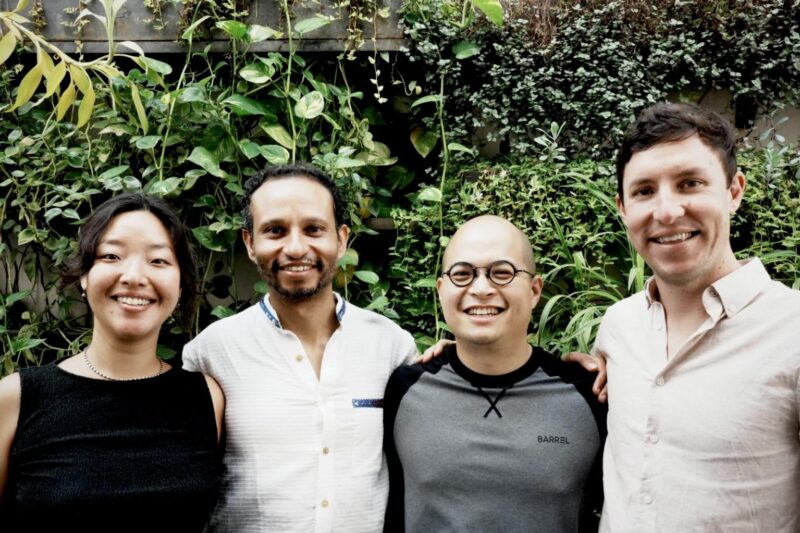
Yoseph Ayele noticed something long before he raised a single dollar for his venture fund. While running Borderless Africa, a platform he started in 2021 to link African founders with global capital, he kept meeting builders in Lagos, Nairobi and Johannesburg solving real problems that international investors simply did not understand.
A month-long tour across four African countries with Ethereum co-founder Vitalik Buterin sharpened that observation. Ayele noticed that founders who had spent months in the same online communities were often meeting face to face for the first time. The continent’s early crypto scene, he realized, was missing the kind of coordination layer that founders in Silicon Valley or Asia took for granted.
ALSO CHECK OUT: Miami Startup GSX Builds Blockchain Rails for Africa
That insight led him to launch magma, a biannual founder residency program under Borderless Africa that has since supported more than 40 startups building financial and trust infrastructure across the continent. But as global interest rates rose after 2022, founders kept telling him the same thing: raising money had become their biggest obstacle. In 2024, he launched LAVA, an early-stage Web3 fund writing checks of $100,000 to $500,000 into African crypto startups.
The fund has since raised $11 million and deployed more than half of it across 18 startups in two years, targeting companies building stablecoin apps, payments infrastructure and digital identity tools. About 16 percent of the portfolio sits in East Africa, anchored by Kenyan stablecoin fintech HoneyCoin, while roughly half has gone into West African, mostly Nigerian, startups. The rest is spread across pan-African and globally facing ventures, including Shield3 and Ultramarkets.
LAVA’s backers include a heavyweight list of operators rather than traditional institutional money. Coinbase chief executive Brian Armstrong, Paradigm co-founders Fred Ehrsam and Matt Huang, Figma boss Dylan Field, and founders tied to Notion, Polygon, Celo, Base and Huobi all sit among its limited partners.
In an interview with TechCabal, Ayele and LAVA chief technology officer Andy Tudhope explained why the fund leans so heavily on founder quality over market timing. Ayele argued that the strongest funds globally are run by people who have actually built companies themselves, which gives them a better read on the psychology and decision-making that separates founders who scale from those who stall. Markets shift and products pivot, he said, but the founder remains the one constant worth betting on.
Tudhope, who leads technical diligence, said the fund typically passes on startups either because a founder still has too much learning ahead of them at an early stage, or because they are chasing a trend rather than solving a problem they deeply understand. He pointed to the current rush toward fully licensed, compliant stablecoin products as an example, arguing that regulatory positioning alone rarely builds a lasting business.
Both investors pushed back on the idea that Africa lacks capital. Their view is that too much global money still comes from a theoretical understanding of African markets rather than firsthand experience, which discourages serious investors from underwriting the risk properly. Ayele noted that Africa is not one market but many, and that funds like his exist partly to help outside capital understand the real differences between, say, Nigeria’s stablecoin landscape and Kenya’s.
On exits, a persistent sore point across African tech investing, Ayele said LAVA is still early and has not pursued any yet, but expects a six to ten year horizon typical of early-stage venture bets. He said the fund has deliberately built its LP base around people positioned to become acquirers or open doors to them, rather than leaving exits to chance.
Looking ahead, Tudhope argued that the more interesting opportunities lie beyond simply building on top of dollar-backed stablecoins like Tether or USDC, which he said just exports American monetary dominance onto African rails. He pointed instead to African-native approaches to credit, trade finance and tokenized real-world assets as the areas worth watching closely.
Both investors said skepticism toward African Web3 is healthy, so long as it does not choke off curiosity. Tudhope went further, suggesting Africa may be the region best positioned to fulfill the original promise of decentralized technology, given how many of its currencies still carry the names of former colonial powers and how much of the continent remains locked out of global financial systems.