



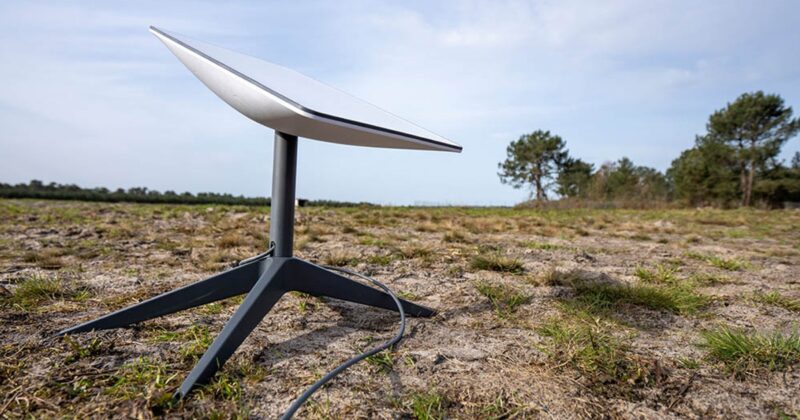
Elon Musk owned satellite internet provider Starlink has officially gone live in Côte d’Ivoire, making the West African nation the 27th market on the continent where the service is commercially available.
The launch follows a licensing process that culminated in June 2026, when Djibril Ouattara, Côte d’Ivoire’s Minister of Digital Transition and Technological Innovation, confirmed that Starlink Network CIV had secured the approvals needed to begin operations. The service runs under a 12 month provisional licence issued by the Autorité de Régulation des Télécommunications and TIC de Côte d’Ivoire, the country’s telecom regulator, permitting Starlink to offer fixed high speed satellite internet nationwide. According to Space in Africa, customers can now order equipment and connect.
Unlike many of Starlink’s earlier entries into African markets that were largely untapped, Côte d’Ivoire already has an established satellite broadband landscape. Orange Côte d’Ivoire partnered with Eutelsat in January 2026 to launch a branded service called Orange Sat, while MTN Côte d’Ivoire followed in April with a multi year agreement to deliver connectivity through Eutelsat Konnect’s high throughput capacity. Both incumbents bring brand recognition, mobile money ecosystems, and extensive retail networks, advantages that Starlink’s direct to consumer model does not carry into the market.
Pricing is expected to be a key battleground. Starlink is offering its residential plan, with speeds of up to 100 Mbps, at roughly 28,746 CFA francs, about 50 dollars a month. That compares with satellite kits from MTN and Orange priced around 150,000 CFA francs, with monthly subscriptions starting near 25,000 CFA francs. The affordability gap on hardware could shape how quickly Ivorian households and businesses adopt the new service over the incumbents’ offerings.
Officials say the priority for Starlink’s rollout is rural connectivity, with an emphasis on reaching schools, health facilities, and remote communities that remain underserved by conventional fibre and mobile infrastructure. Internet penetration in Côte d’Ivoire stood at roughly 40.7 percent by the end of 2025, leaving a significant share of the population without reliable access.
ALSO SEE:Amazon Satellite Internet Set to Launch in South Africa
The launch also lands alongside the country’s commercial 5G rollout, which is beginning in cities with populations above 25,000 through Orange, MTN, and Moov Africa. Analysts tracking the sector expect the market to settle into a dual structure, with satellite serving as backhaul infrastructure for the established telecom operators on one side, and Starlink pursuing direct to consumer and small business customers on the other.
Starlink’s push into Côte d’Ivoire is part of a broader expansion strategy across the continent that began with Nigeria and Rwanda in 2023 and has since extended to markets including Senegal, Chad, Uganda, and the Central African Republic. The company continues to face regulatory resistance in South Africa and was recently denied a licence in Namibia, underscoring how uneven its African rollout remains even as it accelerates elsewhere.