




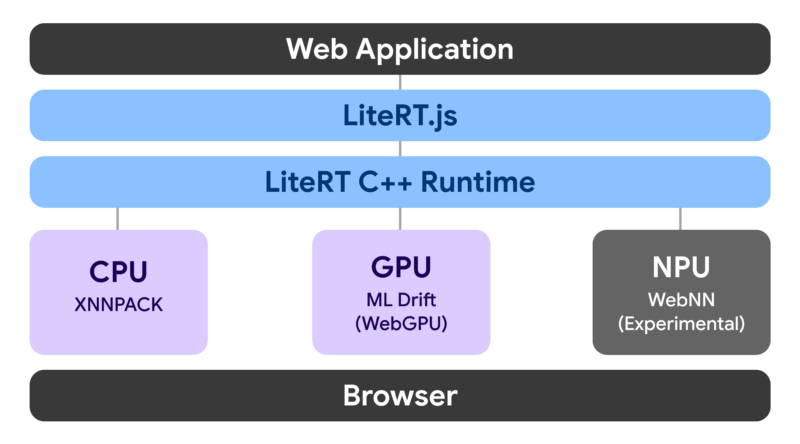
Google has introduced LiteRT.js, a new JavaScript runtime that allows developers to run artificial intelligence (AI) models directly inside modern web browsers instead of relying on cloud servers. The company says the new tool is designed to solve a common challenge for web developers by combining high performance, portability, and easy deployment in a single runtime.
Built for JavaScript and TypeScript applications, Google LiteRT.js enables AI models to process data locally on users’ devices. According to Google, this approach delivers lower latency, improved privacy, zero server costs for inference, and better support for real-time AI experiences.
What is Google LiteRT.js?
LiteRT.js is Google’s JavaScript binding for LiteRT, the company’s on-device AI inference library. It extends Google’s cross-platform AI runtime to the web, allowing developers to deploy machine learning models directly inside browsers using familiar JavaScript APIs.
Instead of sending images, audio, or text to remote servers for processing, LiteRT.js performs AI inference locally. AI inference is the stage where a trained model analyzes new information and generates a result, such as identifying objects in an image, transcribing speech, or detecting faces in a video.
For users, that means faster AI-powered experiences while keeping more personal data on their own devices.
Why Google created LiteRT.js
According to Google, developers have traditionally faced trade-offs when bringing AI to web applications. Many browser-based AI frameworks required balancing performance, portability, and deployment complexity, while cloud-based inference often introduced higher latency and ongoing infrastructure costs.
Google says LiteRT.js removes many of those trade-offs by providing a single runtime that works across modern browsers while automatically taking advantage of available hardware acceleration.
Rather than manually optimizing applications for different devices, developers can build once and let LiteRT.js choose the most suitable execution backend.
Faster AI with built-in hardware acceleration
One of the biggest highlights of LiteRT.js is its performance.
Google says LiteRT.js delivers state-of-the-art AI inference performance, outperforming existing browser AI runtimes by up to three times for supported computer vision and audio processing models. Benchmark testing was conducted on a 2024 Apple MacBook Pro with M4 silicon, and the company notes that actual performance will vary depending on hardware and browser configuration.
The runtime achieves these gains by automatically using optimized hardware backends, including:
- XNNPACK for CPU acceleration
- WebGPU for GPU acceleration
- WebNN for dedicated Neural Processing Units (NPUs), where supported
Google also says GPU and NPU acceleration can deliver 5x to 60x faster performance than standard CPU execution for demanding workloads such as object tracking, image manipulation, and audio transcription.
What developers can build with LiteRT.js
Google LiteRT.js supports a wide range of browser-based AI applications.
Developers can build features such as:
- Image classification
- Object detection
- Speech recognition
- Audio processing
- Image segmentation
- Text generation
- Real-time webcam analysis
Google also showcased demonstrations including browser-based vector search using Embedding Gemma, real-time depth estimation from webcam footage, AI-powered image upscaling with Real-ESRGAN, and Ultralytics YOLO object detection running directly inside the browser.
Because these applications run locally, users can benefit from lower latency while developers reduce their dependence on cloud infrastructure.
Easier deployment for AI developers
Google is also making it easier to bring existing AI models to the web.
LiteRT.js supports one-step conversion of PyTorch models through LiteRT Torch and offers tailored quantization tools to reduce model size while preserving performance. The runtime also supports existing .tflite models, making it easier for developers already using LiteRT to deploy applications across multiple platforms.
Since LiteRT.js shares the same runtime as LiteRT on Android, iOS, desktop, and embedded devices, improvements to the underlying platform automatically benefit web applications as well.
Part of Google’s broader AI strategy
LiteRT.js is the newest member of Google’s LiteRT family and reflects the company’s broader push toward on-device AI.
Instead of depending entirely on cloud computing, Google is steadily expanding the ability of smartphones, computers, and now web browsers to run AI models locally. This approach can improve responsiveness, strengthen privacy, and reduce the computing costs associated with cloud-based AI services.
Google says future updates to LiteRT.js will focus on expanding WebNN support for native NPU acceleration and improving on-device generative AI capabilities.
As browsers become more powerful, LiteRT.js positions the web as another major platform for running AI applications, giving developers a unified way to deploy intelligent experiences across mobile devices, desktops, and the browser.
READ ALSO: Court Voids ARCON’s N60bn Facebook Fine Over Fair Hearing
AI Race Shifts Gears as OpenAI, Meta, and SpaceXAI Trigger Massive Price War with New Model Launches
Beyond Likes and Views: Rwanda’s JimVio Is Turning Creators into AI Powered Businesses
South Africa Rolls Out 600 Biometric Scanners for Immigration
Kenyan Court Rules Banks, Telcos Liable in $34,000 SIM Swap Fraud Case