



Artificial intelligence has transformed industries ranging from finance to healthcare, but one of its most significant applications could be in one of the world’s oldest and most capital-intensive sectors: oil and gas.
London-based industrial AI startup Applied Computing believes it can help energy companies prevent costly equipment failures before they occur. The company has developed an AI model designed to monitor entire oil and gas facilities, continuously analyzing operational data to detect potential problems days before they lead to unplanned shutdowns.
As they develop an AI Model that Predicts Equipment Failures in Oil and gas plants, the vision has attracted investor confidence. Applied Computing recently secured $20 million in Series A funding, led by engineering and technology firm KBR, with participation from Databricks Ventures. The fresh capital will be used to expand the company’s engineering team, accelerate product development, and deploy its AI platform across more industrial sites.
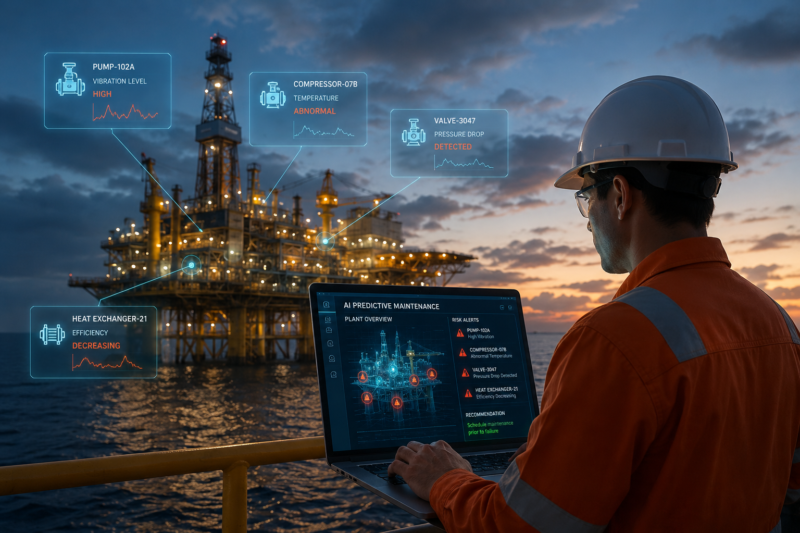
Unlike conventional AI tools built for chatbots or office productivity, Applied Computing’s flagship model, Orbital, is designed specifically for industrial environments. The system analyzes massive volumes of operational data generated by equipment such as pumps, compressors, pipelines, valves and processing units, giving operators a comprehensive view of how an entire plant is performing.
The startup says industrial facilities generate enormous amounts of sensor data every second, yet much of it goes unused because it is scattered across different monitoring systems. Orbital brings that information together, helping engineers identify hidden patterns that could signal an impending equipment failure or operational inefficiency.
For oil and gas companies, the financial implications could be significant.
An unexpected failure of a critical pump or compressor can halt production for hours or even days, costing operators millions of dollars in lost output while emergency repairs are carried out. By identifying early warning signs before equipment breaks down, companies can perform maintenance during planned shutdowns rather than reacting to costly emergencies.
The technology could also reduce maintenance expenses by helping engineers replace only components that actually need attention instead of relying on rigid maintenance schedules. This predictive approach has the potential to extend equipment lifespan while lowering overall operating costs.
SEE ALSO: Lululemon Backs French Nylon Recycling Startup Syntetica in $30M Series A Funding Round
Beyond preventing breakdowns, the AI is designed to optimize how industrial plants operate. It can recommend adjustments that improve energy efficiency, identify process bottlenecks and help facilities maintain stable production, allowing operators to produce more while consuming fewer resources.
Safety is another area where the technology could have a meaningful impact. Early detection of abnormal pressure, temperature or flow conditions could allow operators to address potential hazards before they escalate into incidents that threaten workers, equipment or the environment. AI Model that Predicts Equipment Failures in Oil and Gas Plants
Applied Computing is positioning Orbital as more than a monitoring tool. The company describes it as a foundation AI model capable of understanding the complex relationships between thousands of assets operating simultaneously within an industrial facility, enabling engineers to make faster and more informed decisions.
The investment comes as the global energy industry increasingly embraces artificial intelligence to improve efficiency and reduce costs. With oil producers under growing pressure to maximize output while cutting operational expenses and emissions, predictive AI platforms are becoming an important part of the industry’s digital transformation.
If Applied Computing succeeds in delivering on its promise, the technology could reshape how oil and gas companies manage their operations not by replacing engineers, but by giving them an intelligent system capable of identifying problems before they become multi-million-dollar failures.