




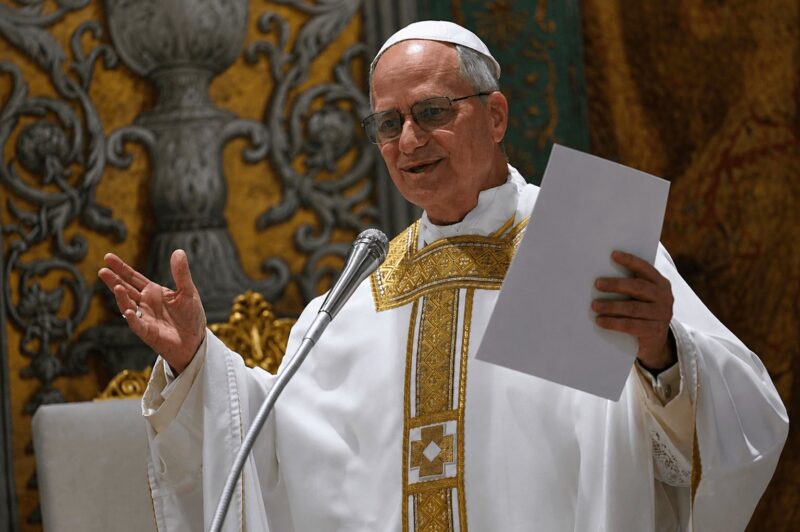
For years, the global conversation around artificial intelligence has mostly focused on productivity, chatbots, and the race to build smarter systems. But in Magnifica Humanitas (“Magnificent Humanity”), Pope Leo XIV shifts the conversation somewhere far darker: the weaponization of intelligence itself.
The Vatican’s new document is not simply asking whether AI can improve human life. It is asking what happens when governments, militaries, and corporations begin handing power, surveillance, and even life-and-death decisions to machines.
At the center of the encyclical is a direct warning to the world: humanity must “disarm AI” before the technology becomes a system of domination rather than progress.
That warning arrives at a moment when artificial intelligence is rapidly moving into warfare and geopolitical competition. Autonomous drones are already reshaping modern conflict. Governments are investing billions into military AI systems. Tech companies that once focused on consumer products are now signing defense contracts and building frontier models with national security applications in mind.
The concern raised in Magnifica Humanitas is not that AI itself is evil. The warning is about what happens when intelligence becomes industrialized and concentrated in the hands of powerful institutions operating faster than laws, ethics, or public understanding can keep up with.
Pope Leo XIV argues that machines should never be allowed to make irreversible human decisions without accountability. In practical terms, that means resisting a future where algorithms decide who gets targeted in war, who is watched by surveillance systems, or who is manipulated by AI-generated information campaigns.
The document also warns against reducing human beings to data points inside automated systems designed for efficiency, prediction, and control. It frames AI not just as a technological revolution, but as a moral turning point that could reshape how societies value human dignity, responsibility, and freedom.
But Magnifica Humanitas goes beyond warfare. The encyclical also addresses what Pope Leo XIV describes as “new forms of slavery” emerging around artificial intelligence and the global systems supporting it.
The document points to the growing trail of human and environmental exploitation behind modern AI systems, from copyrighted material used to train models to the extraction of rare minerals powering AI hardware. While AI companies present the technology as clean and futuristic, the Pope warns that the industry is still deeply tied to labor exploitation, resource extraction, and unequal power structures.
In one of the most striking moments in the document, Pope Leo XIV reflects on the Catholic Church’s own history with slavery, acknowledging that the institution was slow to fully condemn it. Referencing the gradual evolution of Church doctrine in the 19th century, he writes: “For this, in the name of the Church, I sincerely ask for pardon.”
The comparison appears intentional. Just as past societies normalized exploitation in the pursuit of economic growth and power, the Vatican fears artificial intelligence could create new systems of inequality and dehumanization before ethical boundaries are fully established.
What makes the timing significant is that the AI race is accelerating globally with almost no signs of slowing down. The United States, China, and other major powers increasingly view artificial intelligence as a strategic weapon capable of reshaping economics, cybersecurity, intelligence gathering, and military dominance. In that environment, calls for restraint are becoming increasingly rare.
That is what makes the Vatican’s intervention notable. Rather than celebrating AI as an unstoppable breakthrough, Magnifica Humanitas challenges the assumption that every technological capability should automatically be pursued simply because it is possible.
The encyclical repeatedly pushes the idea that humanity risks building systems it cannot fully control. Not because machines suddenly become conscious, but because human institutions may become too dependent on them, too competitive to slow down, or too blinded by power to recognize the consequences.
In many ways, the document reads less like a rejection of technology and more like a warning about human ambition itself. The fear is not only artificial intelligence, but the possibility that societies gradually surrender moral responsibility to automated systems designed around optimization, surveillance, and strategic advantage.
Whether world leaders or technology companies listen is another matter entirely. The economic and military incentives behind AI development are enormous, and the race for dominance is already well underway.
But with Magnifica Humanitas, Pope Leo XIV has inserted the Vatican directly into one of the defining debates of the century. And at a moment when much of the world is focused on building more powerful AI systems, the Church is asking a different question entirely: