




Something significant is happening in Nigeria’s financial system, and it goes far beyond the usual fintech buzz. The country’s freshly minted National Payment Stack (NPS), a next-generation digital payment infrastructure developed by the Nigeria Inter-Bank Settlement System (NIBSS), has already clocked over 153,000 transactions during its pilot phase. That number is not just a statistic. It is a signal, loud and clear, that Nigeria is no longer just keeping up with the global payments revolution. It is actively driving it.
To understand why this matters, you have to step back and look at where Nigeria’s payment system has been. In 2011, NIBSS introduced the NIBSS Instant Payments (NIP) system, a groundbreaking solution that made Nigeria one of the first countries on the African continent to offer real-time, account-based digital payments. For over a decade, that system served millions of Nigerians well. But the digital economy does not stand still. Between 2015 and 2024, transactions processed through NIP grew more than tenfold, eventually surpassing 9 billion annually. The old rails were holding, but the cracks were showing. Scaling was becoming harder, the number of participants was multiplying, and the system was beginning to strain under the weight of Nigeria’s soaring fintech adoption.
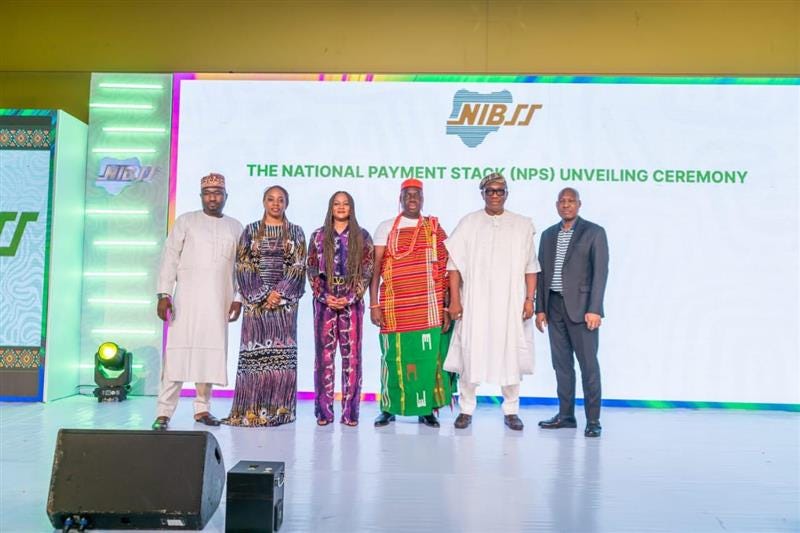
That is the problem the National Payment Stack was built to solve. Unveiled in June 2025 at a high-profile ceremony in Lagos, attended by senior representatives from central banks and payment regulators across 20 African countries, the NPS was positioned from day one as more than a domestic upgrade. NIBSS Managing Director and CEO, Premier Oiwoh, made the ambition plain: this was not just another payment system. It was Nigeria planting a flag in the future of continental finance.
The first real-world proof came on November 7, 2025, at exactly 11:56 a.m. That was the precise moment fintech company PalmPay and Wema Bank executed the very first live transaction on the NPS. The payment cleared in milliseconds with instant settlement, a feat that would have been worth a press release on its own. But it was only the beginning. From that single transaction, the system quickly scaled through its pilot phase, processing over 153,000 transactions and demonstrating the kind of robustness that had been promised on paper now validated in practice.
What makes the NPS architecturally different from its predecessor is not just speed, though speed is certainly a part of it. The platform is built on the ISO 20022 global messaging standard, the same standard now mandated by the Central Bank of Nigeria (CBN) for all electronic financial transactions.
This matters enormously. ISO 20022 enables richer transaction data, better fraud detection, and smoother interoperability with international payment systems. It aligns Nigeria’s infrastructure with what the world’s leading payment corridors are already using. When a Nigerian bank processes a cross-border remittance to a European institution, both sides are now speaking the same financial language.
The security architecture has also been substantially overhauled. Multi-layer authentication, digital signatures, and advanced transaction risk profiling are baked into the NPS from the ground up.
This is not a cosmetic upgrade. It is a rethink of how trust is established in every payment. In a country where digital fraud has historically been a concern that many users factor into their daily banking decisions, this redesign is not just technical. It is psychological. It is about giving ordinary Nigerians the confidence to transact digitally without hesitation.
Financial inclusion is the dimension of this story that perhaps does not get enough attention in the early headlines. Nigeria still has roughly 38 million adults who are unbanked, people who have been left on the edges of the formal financial system for reasons ranging from geographic inaccessibility to the prohibitive cost of traditional banking.
The NPS was explicitly designed with them in mind. Its multi-rail architecture allows mobile money operators, fintechs, and payment service providers to connect directly to the national payments grid, not just banks. This structural shift opens the door for products that can reach people in rural communities, market traders, small farmers, and gig workers who have been transacting purely in cash for years. The CBN has set an ambitious target: 95% financial inclusion by 2028, which would mean bringing an estimated 15 million more Nigerians into the formal financial fold. The NPS is the pipe through which that ambition flows.
There is also a government efficiency angle that is easy to overlook. Because NPS supports richer transaction data, meaning payments can carry more contextual information like purpose codes and unique references, it dramatically improves the state’s ability to track government-to-person transfers, tax receipts, and social benefit disbursements in real time.
Taiwo Oyedele, chairman of the Presidential Fiscal Policy and Tax Reform Committee, confirmed that the NPS will play a central role in Nigeria’s updated tax laws that took effect in January 2026. When the infrastructure can tell you not just that money moved but why it moved, tax compliance becomes easier to verify and harder to game.
The broader economic stakes are also explicit in how NIBSS has framed this launch. Nigeria is pursuing a $1 trillion economy target within the next several years. Premier Oiwoh has been direct: you do not build a trillion-dollar economy on payment infrastructure designed for a fraction of that scale. The NPS is designed to handle the volume, velocity, and variety of transactions that a genuinely large modern economy requires, bulk payments, single transfers, government disbursements, cross-border settlements, and everything in between, all on a single unified rail.
And Nigeria is not keeping this blueprint to itself. The NPS launch attracted delegates from 20 African nations who came to Lagos on a study tour, watching and learning. NIBSS has indicated it is ready to support peer countries in building or upgrading their own instant payment systems. That positions Nigeria not just as a domestic fintech leader but as a potential export of financial infrastructure expertise across the continent. In a region where fragmented payment systems are one of the biggest obstacles to intra-African trade under the African Continental Free Trade Area (AfCFTA), a battle-tested, ISO 20022-compliant Nigerian payment stack designed for cross-border compatibility could become a template others want to replicate.
The pilot’s 153,000 transactions are, in one sense, a small number relative to the billions that flow through NIP on an annual basis. But that is not the right way to read it. This is a system that went from zero to 153,000 in a tightly controlled, methodical rollout, beginning with a single transaction between two carefully chosen partners. The fact that it scaled without reported failures, processed payments in milliseconds, and drew no major technical alarms is precisely the point. You build confidence in infrastructure the same way you build trust in anything: one reliable instance at a time.
NIBSS has made clear that full migration from NIP to NPS will be deliberate and phased, with strategies in place to ensure a smooth transition. Banks, fintechs, and payment service providers are being encouraged to complete their onboarding to the new system. The old infrastructure will not disappear overnight, but its days as the primary national payment rail are now numbered.
Nigeria’s National Payment Stack represents something genuinely rare in the story of digital finance: a government-anchored institution making a bold, forward-looking infrastructure bet and then executing on it. The 153,000 transactions logged in the pilot phase are the early chapters of what looks set to be a defining moment for how Africa transacts. For anyone watching the continent’s financial evolution, this is a story worth following closely.