




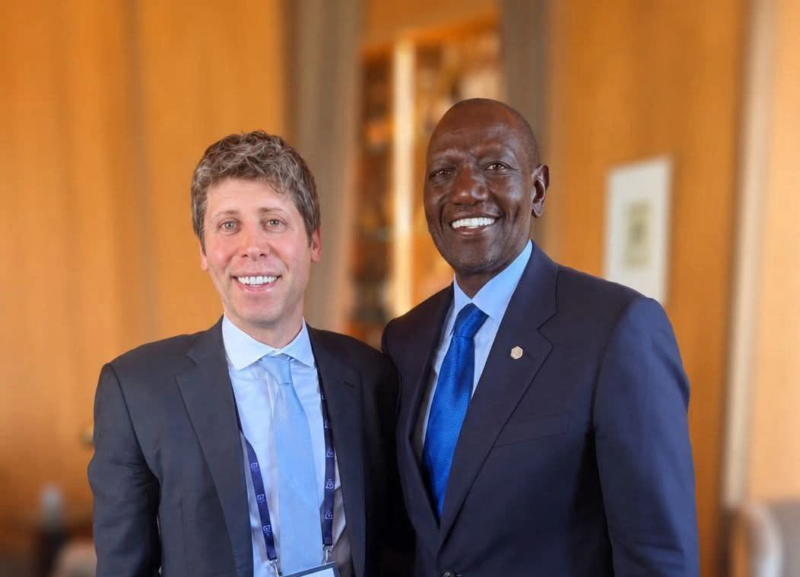
For a country that wants to become Africa’s artificial intelligence capital, Kenya has developed an unusual habit. It celebrates conversations as though they were investments. President William Ruto announced this week that he met OpenAI chief executive Sam Altman on the margins of the G7 Summit in France to discuss establishing Nairobi as home to the first OpenAI Academy in Eastern Africa. The announcement touched the right notes: expanding AI education, strengthening digital skills, supporting educators and learners, and positioning Kenya as a regional hub for AI talent and innovation.
What Ruto did not announce was equally telling. The statement contained no investment figures, no formal agreement, and no timelines. It described discussions around “potential collaboration,” a phrase broad enough to encompass anything from a series of online workshops to a permanent institutional presence. That ambiguity reveals something important about Africa’s place in the emerging AI economy. The continent is chasing symbolism almost as aggressively as it is chasing infrastructure.
The world’s AI race is currently being fought through three scarce resources: compute, capital, and talent. Developed economies like the United States and China dominate on all three fronts. Most African countries, including Kenya, possess relatively little of that infrastructure. Their comparative advantage is people. That explains why education has suddenly become the centrepiece of AI diplomacy. Training programmes are cheaper than building data centres, they create the headlines politicians crave, and they allow governments to show participation in the AI revolution without committing significant public resources. OpenAI understands this perfectly. The company has used education as part of its global expansion strategy in India, Greece, Italy, and Jordan. Every developer trained on its models becomes a potential long-term user, while every university partnership strengthens the company’s ecosystem.
SEE ALSO: Kenya Pushes $20.8M AI Plan to Monitor Social Media
Kenya already possesses one of Africa’s largest pools of software talent. Nairobi hosts regional engineering teams for multinational technology companies like Google and Microsoft. Local startups have built payment systems, logistics platforms, and enterprise software operating across the continent. The talent clearly exists. The question is where the value created by that talent ultimately ends up. One of the underappreciated consequences of AI is that it makes geography less relevant for highly skilled labour. A machine-learning engineer in Kilimani can train models for a company in California or Beijing without ever leaving Nairobi. That keeps salaries flowing into Kenya but does not necessarily build Kenyan AI companies.
In the past decade, African governments measured digital progress through internet penetration and startup funding. AI changes the calculus entirely. The winners may not be the countries with the largest number of developers but those that own computing infrastructure, finance research, and retain intellectual property. On those metrics, Africa still sits on the margins. That is why Ruto’s announcement deserves both optimism and scepticism. Optimism because AI education is indeed important. Kenya needs more engineers, researchers, and institutions capable of understanding and deploying the technology. Scepticism because Africa has a long history of confusing skills programmes with industrial strategy. The continent has seen coding academies, startup incubators, blockchain bootcamps, and innovation hubs come and go. Many produced talented graduates. Far fewer produced significant tech companies. Training people is relatively easy. The real challenge is creating an environment where they build enduring businesses.
Perhaps that is why the announcement feels both important and incomplete. It creates understanding that AI education will shape future competitiveness. It also reflects that Africa’s engagement with AI remains heavily dependent on partnerships with organisations outside the continent. For now, all that exists is a conversation, according to TechCabal.





Interesting to see how AI strategies are evolving in Kenya. What do you think this means for future tech innovations there?