

Since entering Nigeria in 2019, M-KOPA has deployed more than 231 billion naira in credit to over one million customers, establishing smartphone financing as one of Africa’s fastest-growing pathways into formal credit for low-income earners.
The company’s evolution from solar home systems to device financing reveals a critical insight about financial inclusion on the continent, one that hinges on understanding what everyday Africans actually need to participate in the digital economy.
READ ALSO:From Medical School to Health Tech: How 22-Year-Old Ryan Anderson Built Circadify to Diagnose Africa
The shift happened through customer behavior. When M-KOPA initially financed solar home systems in Nigeria, the company quickly realized it was solving only part of the problem. As Babajide Duroshola, M-KOPA Nigeria’s general manager, explained to TechCabal, “Once you finance solar home solutions, you start to ask yourself what you missed. That is when you figure out that everybody needs to be in the digital economy, and access to a smartphone solves this.” For millions of Nigerians, device affordability remains the biggest barrier to internet access. According to GSMA, the global telecom industry body, nearly six in ten Nigerians remain offline largely because smartphones cost too much.
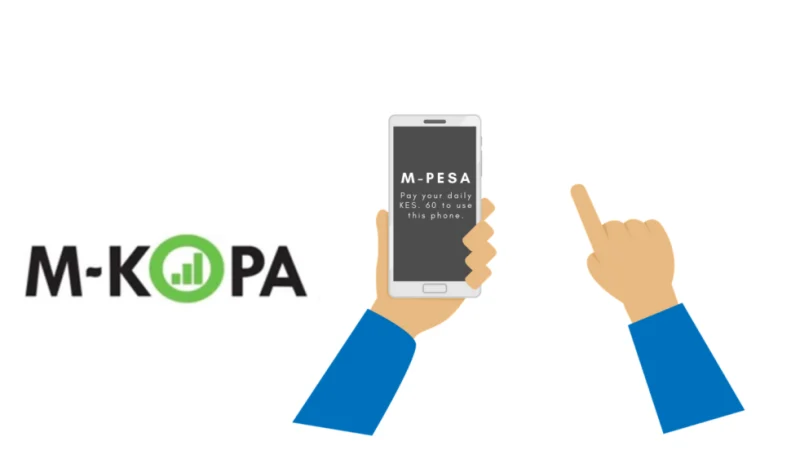
M-KOPA’s approach removes traditional lending barriers entirely. Customers need no collateral, no guarantors, and no proof of income. Instead, they make an initial deposit alongside providing identification, then repay through daily micropayments structured around informal work patterns. The daily repayment model works because it matches how most Nigerians actually earn. As Duroshola noted, “What you start with is what you are ending with. Even if the loan was six months and you pay in six and a half months, we do not add extra charges. It is not an interest-based model.”
Risk management relies on embedded technology within the phones themselves. If repayments stop, M-KOPA can remotely restrict device functionality while still allowing emergency calls. Customers facing hardship can also return devices and receive deposit refunds, a mechanism the company credits with maintaining single-digit default rates. According to M-KOPA’s latest impact report, women now account for 33 percent of borrowers, with 52 percent accessing formal credit for the first time through the platform.
Yet smartphones represent just the starting point. M-KOPA builds credit histories from repayment behavior generated through device financing, creating proprietary credit scores that lower lending risk for subsequent products. This is why cash lending has emerged as the company’s fastest-growing segment. Unlike smartphones, which customers replace every few years, cash loans can be accessed repeatedly once repayment patterns are established. Duroshola said, “With a smartphone, people require one device every few years. But with cash, customers can borrow multiple times within a cycle if they repay on time.”
The impact extends beyond lending. Across Nigeria, 77 percent of M-KOPA customers use financed devices for income-generating activities, while 75 percent report increased earnings after purchase. The company has also become a significant employer, with more than 11,000 agents earning income through its sales network. Local procurement spending reached 27.4 billion naira in 2024, while tax contributions exceeded 2.5 billion naira.
M-KOPA became profitable in 2024, reporting 9.2 million dollars in profit after a 24.7 million dollar loss the previous year as revenue grew 66 percent.
The company plans to expand from its current six states to 20 states within five years, unlocking more than one trillion naira in credit while launching additional products including data bundles. As embedded finance models continue expanding access to consumer credit outside traditional banks, M-KOPA’s smartphone repayment strategy demonstrates how technology-driven lending can succeed where conventional retail credit has struggled with defaults and prohibitive borrowing costs.