




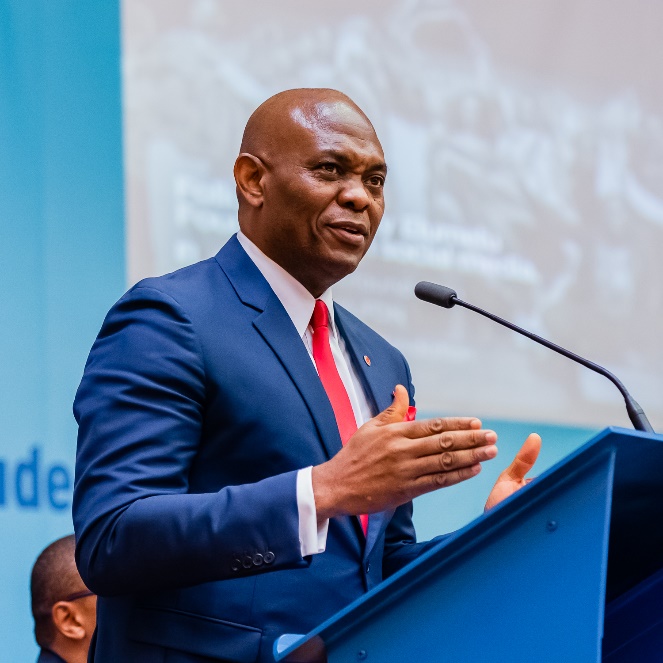
Tony Elumelu’s decision to commit $100 million toward African entrepreneurs a decade ago has turned into one of the continent’s most consequential economic experiments, and the numbers now speak for themselves. Businesses backed by the Tony Elumelu Foundation have collectively generated more than $4.2 billion in revenue and created over 1.5 million jobs across all 54 African countries, according to the foundation’s latest impact figures.
The Nigerian billionaire banker and his wife, Awele Vivien Elumelu, made the pledge in 2015, promising to empower 1,000 young business owners annually over ten years through the Tony Elumelu Foundation. What began as an ambitious wager on African talent has since evolved into the largest philanthropic commitment to entrepreneurship on the continent, supporting more than 27,000 entrepreneurs with mentorship, structured training and non refundable seed grants worth 5,000 dollars each.
Foundation CEO Somachi Chris Asoluka has described the outcomes as proof that entrepreneurship, not aid or government intervention, will define Africa’s economic future. Speaking to mark World MSME Day, she noted that behind every dollar generated is a business meeting a real market need, and behind every job created is a family gaining greater income stability. The foundation has disbursed more than 130 million dollars in seed capital to date and trained over 2.5 million Africans through its digital platform, TEFConnect.
Demand for the programme has far outpaced expectations. By its third year, hundreds of thousands of entrepreneurs across the continent were already competing for limited slots. Elumelu has said the response revealed how many talented Africans simply lacked access to opportunity rather than ambition or ability. The most recent cohort drew over 265,000 applications from all 54 countries, with 3,200 entrepreneurs eventually selected following an independent vetting process conducted by Ernst and Young.
One of the more striking shifts has been in gender representation. Women now make up more than half of the entrepreneurs supported by the programme, a sharp rise from the early years when female beneficiaries were a small minority. Foundation officials say this was not the result of a quota but of merit, with female applicants consistently submitting stronger business plans and clearer models.
Elumelu has long championed a philosophy he calls Africapitalism, which argues that Africa’s private sector, led by its entrepreneurs, must take the lead role in driving the continent’s economic and social transformation. He has been vocal in criticizing long term dependence on foreign aid, insisting instead that empowering Africans to build wealth and solve local problems offers a more sustainable path to development.
Despite the scale of impact, challenges persist for many beneficiaries. A significant share of alumni report spending a large portion of their revenue on off grid power and fuel for generators, while regulatory bottlenecks and infrastructure gaps continue to weigh on business growth across several African markets. The foundation says it continues to engage governments on the continent to address these constraints as it prepares to scale support for future cohorts.