




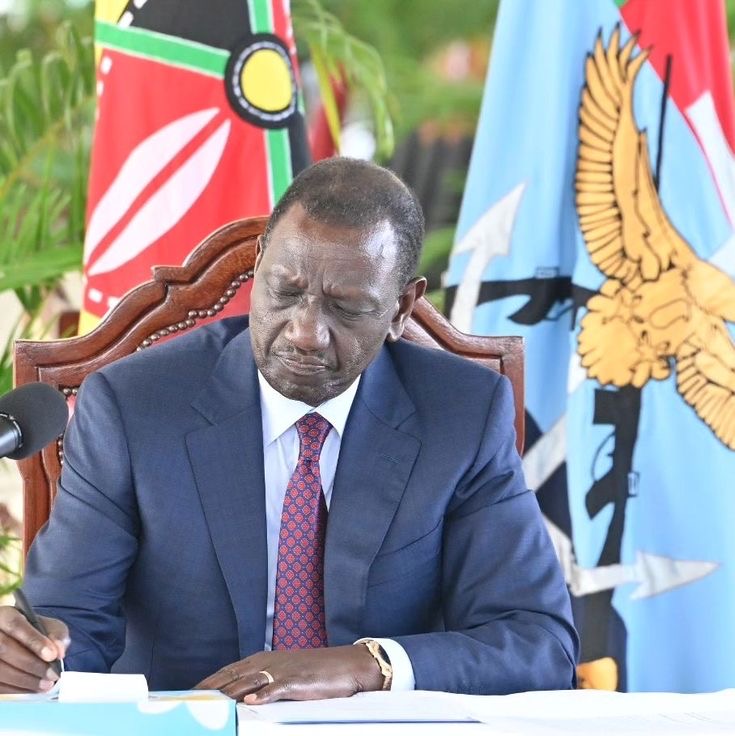
In a major move to protect East Africa’s largest economy from economic shocks, Kenyan President William Ruto has officially signed into law the Central Bank of Kenya (Amendment) Bill, 2026. The new legislation introduces sweeping structural reforms, significantly expanding the Central Bank of Kenya’s (CBK) powers to intervene during severe banking crises while tightening the rules for bailing out struggling lenders.
The legislation formally draws a line between routine monetary policy like setting interest rates and emergency bailouts, a move designed to protect public funds from being used to prop up fundamentally broken financial institutions.
Following the signing ceremony at State House in Nairobi, President Ruto emphasized that the framework is built to safeguard the country’s broader financial ecosystem while remaining highly accountable to the public.
“The new law introduces a distinct legal framework separating the Central Bank’s routine monetary policy operations from Emergency Liquidity Assistance (ELA),” President Ruto stated. “The move will improve Kenya’s preparedness to respond to financial crises while protecting taxpayers and the banking sector.”
Under the updated framework, the CBK will no longer hand out lifeline loans unconditionally. Weak or mismanaged institutions will have to prove they meet rigid metrics to qualify for extraordinary government backing.
“Under the amendment, ELA can only be extended to banks that meet strict conditions on solvency, viability, and systemic risk,” Ruto explained. “The provision aims to separate ordinary liquidity management from extraordinary interventions during periods of financial distress.”
For qualified but temporarily struggling commercial banks and microfinance institutions, however, the law offers a much longer runway to recover. The window for emergency financial assistance has been doubled, extending from the previous six-month cap to a maximum of 12 months. Financial analysts note this buffer will give viable lenders the necessary breathing room to resolve short-term cash flow shortages without triggering a panic in the wider market.
Beyond crisis management, the 2026 amendment repositions the CBK on the global stage by broadening its authority over national reserves. While the central bank was previously restricted to dealing primarily in gold and foreign exchange, the new law explicitly broadens its mandate to buy, sell, import, export, and refine other high value commodities.
“The bank shall buy, sell, export, import, transfer, hold, refine, or otherwise deal in gold, gold coins and bullion, silver, platinum, any other precious metal or foreign exchange under such terms and conditions as it shall determine,” the Act states.
The Kenyan government expects this particular provision to heavily support the domestic mining sector, aligning Kenya with gold and precious metal reserve strategies already utilized by other major African economies like South Africa, Ghana, and Tanzania.
Ultimately, the legislation marks a significant transition for Kenya’s financial sector, modernizing its regulatory toolkit to match international standards of market integrity and systemic resilience. As President Ruto concluded, the law successfully “formally recognises the CBK’s role in promoting the integrity, resilience, and proper functioning of Kenya’s financial system.”