


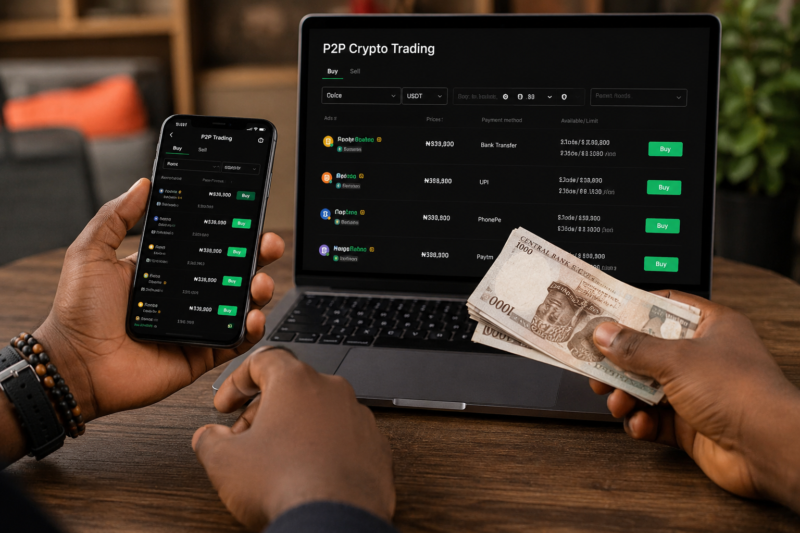
OKX has switched its lights back on for Nigerian crypto traders, restoring peer-to-peer trading and full platform access nearly two years after pulling out of the country entirely. The move marks one of the clearest signals yet that the frosty relationship between global crypto exchanges and Nigerian regulators is finally beginning to thaw.
For thousands of Nigerian traders, this is more than a routine platform update. OKX was never a fringe player in the local market. It was one of the primary exchanges people relied on daily, and its exit in 2024 left a gaping hole that many users are still talking about today. The exchange first disabled naira P2P trading in May 2024, then followed up in July with an email informing Nigerian users that all services would be discontinued from August 16, giving them just two weeks to withdraw funds or reach out to support before the shutters came down completely.
That withdrawal did not happen in isolation. It came shortly after Binance suffered its own very public fallout with Nigerian authorities, an episode that saw two of its executives detained in the country, with one of them held for months before being released on health grounds. Nigerian officials accused P2P platforms of being used to manipulate the naira, arguing that informal dollar to naira rates set by traders were undercutting the official exchange rate at a time when the currency was already in freefall. Crypto exchanges became a visible and convenient target for a government under pressure to explain the naira’s collapse.
A lot has shifted since then. President Bola Tinubu signed the Investments and Securities Act into law in March 2025, a move that formally recognized cryptocurrencies as legal investment assets and gave the Securities and Exchange Commission clear authority to oversee the sector. That legislation paved the way for the SEC’s Accelerated Regulatory Incubation Programme, a framework that allows crypto exchanges to apply for provisional licences to legally serve Nigerian users. OKX’s return, complete with active P2P functionality, strongly suggests the exchange has worked through some version of that process, either directly through ARIP or through separate engagement with regulators.
READ ALSO:Miami Startup GSX Builds Blockchain Rails for Africa
OKX has not put out a detailed statement explaining the exact terms of its comeback, and that leaves an important gap for users to fill in themselves. Anyone planning to move funds back onto the platform would be wise to first confirm exactly where OKX now stands with the SEC before transacting at scale. Details on licensing status are still not fully public, and traders who got burned by sudden shutdowns before have every reason to want more clarity this time around.
Nigeria remains one of the biggest crypto markets in the world by trading volume, so the return of a major exchange like OKX genuinely changes the landscape. It adds another regulated or semi regulated option alongside platforms such as Quidax and Busha, which managed to hold onto provisional licences and kept serving Nigerian users throughout the crackdown years. For a trading community that has had to adapt constantly to shifting rules and sudden exits, having a familiar and trusted name back in the mix is a welcome bit of stability.