


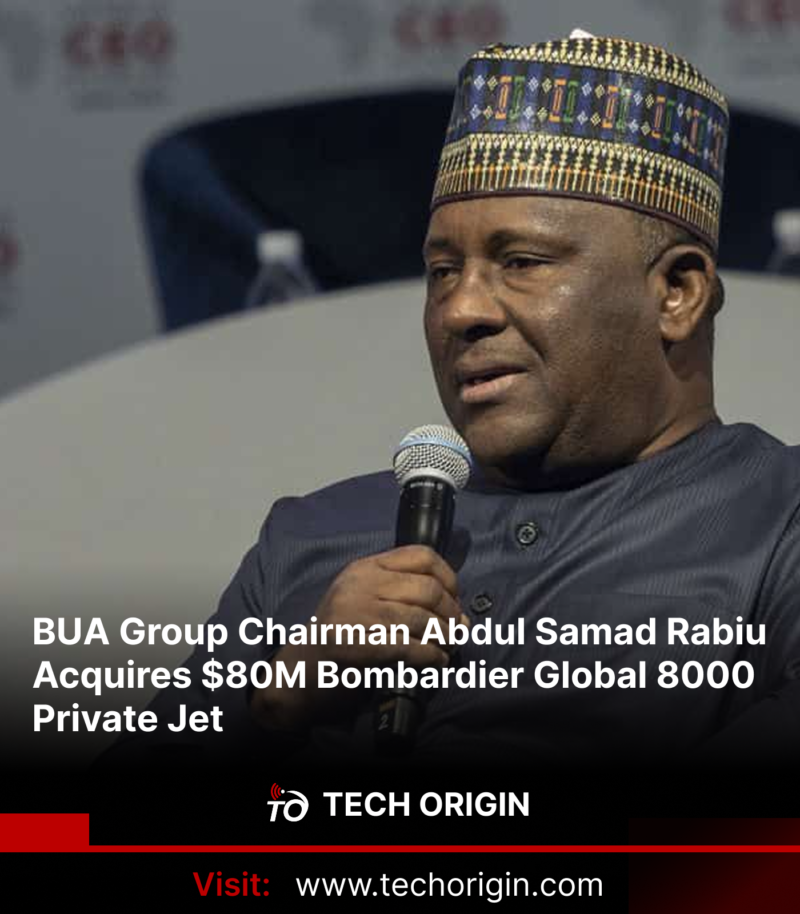
Nigerian industrialist and billionaire Abdul Samad Rabiu has significantly upgraded his corporate aviation capabilities with the acquisition of the ultra luxurious Bombardier Global 8000 business jet, valued between $78 million and $82 million.
The high profile purchase caps off an extraordinary period of financial growth for the BUA Group Chairman, whose net worth surged to $8.5 billion, cementing his position as Africa’s fourth-richest individual.
The Bombardier Global 8000 is celebrated as the world’s fastest civilian aircraft since the Concorde, boasting a top operating speed of Mach 0.95. With an extraordinary non stop range of 8,000 nautical miles, the aircraft allows Rabiu to fly effortlessly from Lagos to New York, or Dubai to Houston, without refueling
Insiders close to the billionaire state that while the aircraft is undoubtedly a symbol of prestige, it serves primarily as a critical strategic asset. Designed to optimize executive travel, the jet features four fully appointed living spaces and the lowest cabin altitude in its class, ensuring maximum productivity and comfort during grueling intercontinental itineraries.
“For a businessman whose operations are rapidly scaling across Africa, Europe, and the Middle East, this aircraft provides the logistical efficiency required to manage a multi billion dollar empire in real time,” an industry analyst noted.
The acquisition follows a record breaking financial run for Rabiu’s conglomerate, BUA Group, which has continued its aggressive expansion across the cement, foods, infrastructure, and energy sectors. Notably, BUA Foods Plc remains one of the largest companies by market capitalization on the Nigerian Exchange (NGX).
The contract for the flagship aircraft was quietly finalized at BUA’s Dubai office just days before the model officially entered global commercial service, making Rabiu the first African owner of the coveted jet.
As BUA Group pushes forward with massive, large scale projects including refinery developments and port expansions the Global 8000 is expected to become the central corporate workhorse driving the conglomerate’s next phase of cross-border investments.