

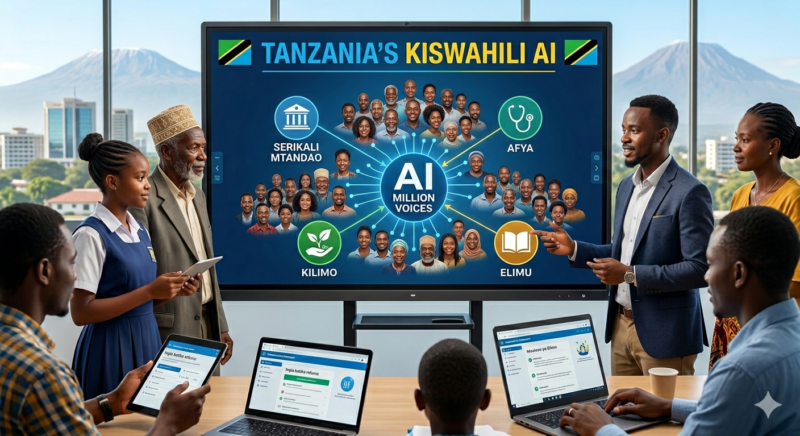
A bold national strategy is placing over 100 million swahili speakers at the center of East Africa’s AI revolution.
Artificial intelligence(AI) has largely developed in English, leaving millions of African users on the margins of the digital economy. Now, Tanzania is taking a bold step to change that.
As part of its 2026/2027 Digital Transformation Strategy, Tanzania as underdeveloped country is developing a (swahili) Kiswahili-based AI language model designed to serve citizens in the language they are using every day. The initiative will become one of the Africa’s most important breakthroughs in local-language artificial intelligence, putting up a precedent for inclusivedigital development across the continent.
What Is Tanzania’s Kiswahili AI Initiative?
This project is aimed at building an advanced Swahili artificial intelligence model trained specifically in Kiswahili, East Africa’s most widely spoken language.
Unlike global AI systems built primarily around English-language datasets, Tanzania’s Kiswahili AI will be designed to understand local linguistic context, cultural nuance, and regional communication patterns.
The model is expected to power the following:
- AI-driven government services
- Smart educational learning tools
- Healthcare chatbots and digital health assistants
- Agricultural advisory platforms for farmers
- Localized digital customer support systems
By building AI around Kiswahili (swahili), Tanzania is ensuring technology adapts to people — not the other way around.
Why Tanzania’s Kiswahili AI Matters
Digital exclusion in Africa is often a language problem.
Millions of smartphone users have internet access but cannot fully engage with digital platforms because most software interfaces, assistants, and AI tools are built for English-speaking audiences.
By prioritizing Kiswahili AI development, Tanzania is addressing a critical barrier to digital inclusion.
This strategy recognizes a simple reality: technology becomes powerful only when people can interact with it naturally.
A Regional Opportunity for East Africa
Kiswahili is an official or widely spoken language in:
- Kenya
- Uganda
- Rwanda
- Democratic Republic of the Congo
- Tanzania
That gives Tanzania’s AI model the potential to serve hundreds of millions of people across East and Central Africa, turning it into a regional public digital asset.
If successful, it could accelerate AI innovation throughout the African technology ecosystem.
SEE ALSO:OpenAI Latest Model is An Autistic Genius – OpenAI CEO
Challenges Tanzania Must Overcome
Building a world-class Kiswahili AI model will not be easy.
Key challenges include:
Training Data Availability
Large AI systems require enormous amounts of clean, diverse language data.
Dialect Diversity
Kiswahili varies across regions, requiring careful linguistic balancing.
Computing Infrastructure
AI model training demands advanced computing power and sustained investment.
Long-Term Sustainability
The project will need consistent policy backing and technical expertise to remain globally competitive.
What Tanzania’s AI Strategy Means for Africa
Tanzania’s Kiswahili AI initiative is bigger than a national tech project.
It represents a shift in how Africa approaches digital innovation — not by waiting for global technology companies to adapt their systems, but by building solutions rooted in local realities.
If Tanzania succeeds, it could provide a blueprint for countries across Africa to create AI systems in indigenous and regional languages.
The message is clear: Africa does not need to wait for inclusion in the digital future.
It can build one in its own voice.
What Is Tanzania’s Kiswahili AI Initiative?
This is a project aimed at building an advanced Swahili artificial intelligence model trained specifically in Kiswahili, East Africa’s most widely spoken language.
Unlike global AI systems built primarily around English-language datasets, Tanzania’s Kiswahili AI will be designed to understand local linguistic context, cultural nuance, and regional communication patterns.
The model is expected to power:
- AI-driven government services
- Smart educational learning tools
- Healthcare chatbots and digital health assistants
- Agricultural advisory platforms for farmers
- Localized digital customer support systems
By building AI around Kiswahili, Tanzania is ensuring technology adapts to people — not the other way around.
Digital exclusion in Africa is often linked to a language problem.
Millions of smartphone users in Africa have internet access. Still, they cannot fully engage with digital platforms because most software interfaces, assistants, and AI tools are built for English-speaking users.
By prioritizing Kiswahili AI development, Tanzania is breaking a critical barrier to digital inclusion.
This strategy recognizes a simple reality:
Technology becomes powerful only when people can interact with it naturally.
Kiswahili (SWAHILI) is a widely spoken language in the following countries:
- Kenya
- Uganda
- Rwanda
- Democratic Republic of the Congo
- Tanzania
This gives Tanzania’s AI model the potential to serve hundreds of millions of people across East and Central Africa, turning it into a regional public digital asset.
If successful, it could accelerate AI innovation throughout the African technology ecosystem.
Challenges Tanzania Must Overcome
Building a world-class Kiswahili AI model will not be easy.
Key challenges include:
Training Data Availability
Large AI systems require enormous amounts of clean, diverse language data.
Dialect Diversity
Kiswahili varies across regions, requiring careful linguistic balancing.
Computing Infrastructure
AI model training demands advanced computing power and sustained investment.
Long-Term Sustainability
The project will need consistent policy backing and technical expertise to remain globally competitive.
What Tanzania’s AI Strategy Means for Africa
Tanzania’s Kiswahili AI initiative is bigger than a national tech project.
It represents a shift in how East Africa approaches digital innovation, not by waiting for global technology companies to adapt their systems, but by building solutions rooted in local realities.
If Tanzania succeeds, this could provide a blueprint for countries across Africa to create AI systems in indigenous and regional languages.
In summary, Africa does not need to wait for inclusion in the digital future; it can build one in its own voice.