




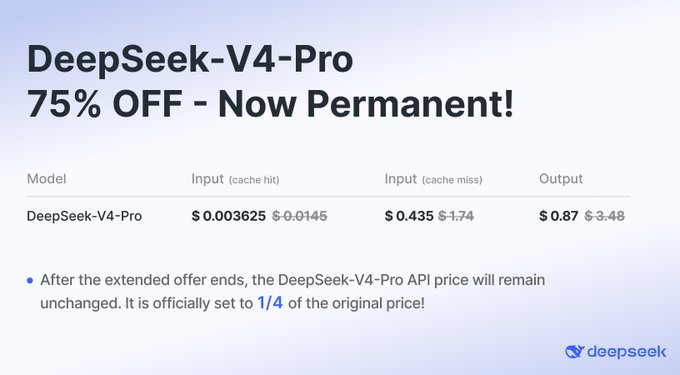
Chinese AI company DeepSeek has officially confirmed that the massive 75% discount on its V4-Pro AI model is no longer temporary. The lower pricing is now permanent, and the decision is already sending shockwaves across the AI industry.
On the surface, it looks like a simple price cut. In reality, it could become one of the most important moments in the current AI race.
For the past two years, companies like OpenAI, Anthropic, and Google have operated on the assumption that the most powerful AI models would continue commanding premium prices. DeepSeek is challenging that idea directly by offering advanced AI performance at a fraction of the usual cost.
According to updated pricing information, DeepSeek’s V4-Pro now costs around $0.435 per million input tokens and about $0.87 per million output tokens. That is dramatically lower than pricing seen across most leading frontier AI models.
For regular users, those numbers may not mean much. But for developers building AI tools, coding assistants, research agents, automation systems, or enterprise AI products, this changes the economics completely.
A startup processing hundreds of millions of tokens every month could suddenly reduce operational costs from thousands of dollars to just a few hundred. That creates a major advantage for smaller developers who previously could not afford large-scale AI infrastructure.
And that is where the real story begins.
The AI industry is slowly shifting from a battle over who has the smartest model to a battle over who can deliver “good enough” intelligence at the lowest possible cost.
That matters because most businesses do not necessarily need the absolute smartest AI model available. They need models that are fast, reliable, and affordable enough to run continuously without destroying profit margins.
DeepSeek appears to understand this very well.
Instead of focusing only on premium positioning, the company is aggressively pushing AI toward commodity pricing — similar to what happened in cloud computing years ago. Once pricing drops low enough, adoption tends to accelerate quickly because developers begin building products around the cheaper infrastructure.
And once developers build around your ecosystem, switching becomes harder.
The move is also raising bigger geopolitical questions. Western export restrictions were originally expected to slow China’s AI progress by limiting access to advanced chips. But DeepSeek’s ability to sustain these lower prices suggests Chinese AI firms may already be finding ways to reduce infrastructure costs faster than many analysts expected.
Some industry observers believe improving domestic hardware and optimization techniques inside China could be helping companies like DeepSeek operate far more efficiently than before.
At the same time, the pricing move is increasing debate around how frontier AI companies will make money long term.
Many of today’s massive AI valuations were built around the idea that enterprise API access would become an extremely profitable business. But if powerful AI models continue getting cheaper this quickly, profit margins across the industry could come under serious pressure.
READ ALSO: Safaricom Expands My OneApp Support for Airtel and Roaming Users
That does not mean companies like OpenAI or Anthropic are suddenly in danger. They still lead in several important areas, including ecosystem strength, enterprise trust, reasoning quality, and research capabilities.
But DeepSeek’s strategy introduces something the market cannot ignore: price pressure at scale.
And historically, once price wars begin in technology, they rarely move in reverse.
Whether this becomes a short-term disruption or the start of a larger shift, one thing is becoming increasingly clear: the future winners in AI may not simply be the companies building the most powerful models. They may be the companies that make advanced AI cheap enough for everyone else to build on top of.
READ ALSO: SpaceX launches its biggest, most beefed-up Starship yet on latest test flight