




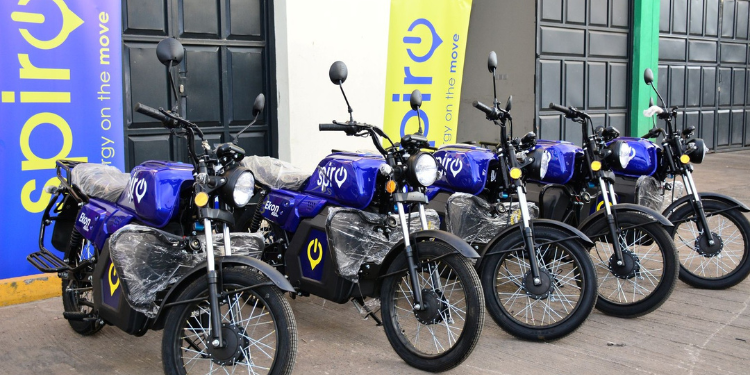
Africa’s electric mobility space just received one of its biggest votes of confidence yet. Spiro, the continent’s fast-growing electric vehicle and battery-swapping company, has announced a landmark $215 million equity investment round, making it one of the largest single funding raises ever recorded by an EV infrastructure company in Africa.
ALSO READ:Spiro Hits 95K E-Motorcycles, Enters Cameroon Market
The announcement came on June 1, and it has already sent a clear signal to the rest of the world that clean transportation in Africa is no longer an experiment. It is a business, and it is scaling fast. Check Techpoint Africa for the full details.
The funding round was backed by Impact Fund Denmark and Equitane, two institutional investors with strong track records in sustainable infrastructure and emerging market development. Their decision to put this level of capital behind Spiro speaks to something bigger than one company’s growth story. It reflects a growing global conviction that Africa’s urban mobility challenge is solvable, and that the companies building practical, affordable solutions on the ground are worth backing at scale.
Spiro currently operates across seven African countries, namely Kenya, Rwanda, Uganda, Togo, Benin, Nigeria, and Cameroon. Across those markets, the company has deployed more than 100,000 electric motorcycles and built over 2,500 battery-swapping stations.
Those numbers alone would make it a standout story in African tech. But what makes this latest raise particularly significant is where the company is headed next. Spiro has confirmed plans to enter Ethiopia and the Democratic Republic of Congo, two of Africa’s most populous nations and two markets where the demand for affordable, reliable transportation is enormous.
The $215 million will be deployed across three clear priorities. The first is densifying the battery-swapping network in markets where Spiro already operates, to keep up with demand that has consistently outpaced infrastructure. The second is funding the entry into Ethiopia and the DRC, which will require building swapping stations, establishing local partnerships, and navigating two very different regulatory environments.
The third, and arguably most forward-thinking priority, is deepening local manufacturing. Spiro already runs assembly and production facilities in Kenya, Rwanda, and Uganda, and operates a dedicated battery recycling plant in Nigeria. The company has set an ambitious target of sourcing 80% of its bike value-addition locally by the first quarter of next year.
That localisation push matters beyond the balance sheet. One of the persistent criticisms of African clean energy projects is that they import finished products, extract economic value, and leave little behind. Spiro is building a different model, one where the vehicles are assembled on the continent, the batteries are recycled on the continent, and the jobs, skills, and industrial capacity stay on the continent.
The company estimates its operations currently support around 6,000 jobs across its active markets, a figure expected to grow meaningfully as the Ethiopia and DRC expansions begin.
The environmental case for what Spiro is doing is equally compelling. A third-party lifecycle assessment of the company’s operations in Kenya found that its electric motorcycles generate approximately 72% lower climate impact than conventional petrol-powered motorcycles. The same study reported an 80% reduction in ozone depletion potential and a 20% reduction in particulate matter emissions.
In cities across Africa where air pollution is a daily public health concern, those numbers carry real weight. The battery-swapping stations themselves are powered by solar energy and connected through IoT technology, and Spiro is exploring second-life applications for used batteries in renewable energy storage, which would extend their value well beyond the vehicles they once powered.
From a fundraising perspective, this latest round caps what has been a remarkable twelve months for the company. Spiro secured a $50 million debt facility in February 2026, followed by a $100 million equity round in late 2025. With this new $215 million, the company has raised over $365 million across three separate rounds in less than a year, cementing its status as one of the most heavily funded clean mobility startups on the continent.
Lars Bo Bertram, Chief Executive Officer of Impact Fund Denmark, put the reasoning plainly. He said his organisation is investing in Spiro and bringing Danish pension capital into one of Africa’s most promising growth markets because the potential for both commercial growth and measurable climate impact is clear. That combination of financial return and real-world impact is exactly what long-term institutional investors are looking for, and Spiro appears to have found the formula that delivers both.
The timing of the announcement does come with some complexity worth noting. Kenya, one of Spiro’s most important markets, is currently debating tax changes that could make electric vehicle manufacturing more expensive by removing key VAT incentives. If those changes go through, they would increase costs for companies assembling EVs locally, which cuts directly against the kind of industrial localisation that Spiro is building toward.
The company’s expanding regional footprint may help cushion the blow of any single market’s policy shifts, but the situation highlights the broader challenge facing Africa’s green mobility sector. Attracting global capital is one thing. Navigating the unpredictable policy environments of a dozen different countries simultaneously is another challenge entirely.
Still, the overall trajectory is hard to argue with. A company that entered its first African market with an unproven battery-swapping model has now deployed 100,000 vehicles, built thousands of swapping stations, raised hundreds of millions of dollars, and earned the confidence of European institutional investors who manage billions in pension capital. Ethiopia and the DRC are not small bets.
They are two of the largest economies on the continent, with massive informal transport sectors and populations that are deeply familiar with motorcycle taxis as a daily mode of movement. If Spiro can replicate even a fraction of what it has built in its existing markets, the growth potential is significant.
Africa’s clean mobility revolution is not coming. It is already here, and Spiro is one of the companies driving it forward.