



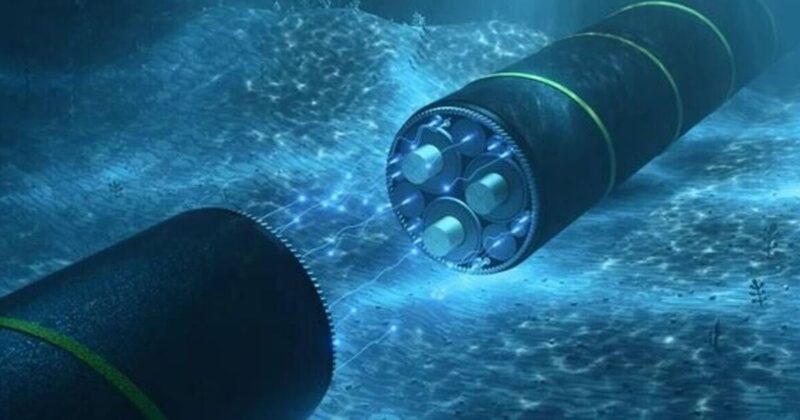
Africa’s internet infrastructure has a critical weak spot, and the International Telecommunication Union says it could leave millions of users stranded the next time a submarine cable snaps. According to a new advisory from the ITU’s International Advisory Body on Submarine Cable Resilience, the entire continent depends on just one permanently stationed repair ship, a vulnerability that experts warn could turn routine cable faults into weeks-long connectivity crises.
The report, adopted in Geneva after a two year study involving 175 experts from government, industry and academia, painted a stark picture of how thin Africa’s safety net really is. Despite growth in internet connectivity, the report found that Africa remains critically underserved by submarine cable repair infrastructure, with having only one submarine cable repair firm meaning the continent could face lengthy internet outages whenever issues arise. That single point of failure is Orange Marine’s Léon Thévenin, based in Cape Town. Although the vessel is associated with the South African city, it is actually stationed in the south of France and has spent years crossing the continent’s coastline to fix broken cables whenever they fail.
READ ALSO: Nigeria Fibre Cuts Hit Record 155,000 in Two Months
The danger, according to the ITU, is not just that one ship exists, but what happens when trouble strikes in two places at once. The report noted that relying on a single ship means that when Africa experiences multiple faults across different countries, repairs will be slow because one location has to wait for the vessel to finish another, giving the example that if a fault occurs near Dakar in West Africa while the ship is working off Mombasa in East Africa, the response time would stretch dramatically. Officials compared the distance involved to a transoceanic voyage, underscoring just how exposed African economies are to a single mechanical or scheduling delay thousands of kilometers away.
This is not a hypothetical concern. The rockfall damaged cables off the Congo River in 2020 and 2023 already gave the continent a preview of what a repair bottleneck looks like, throttling connectivity across financial markets, cloud services and cross border data flows for extended periods. With Africa’s digital economy expanding rapidly, from mobile banking to cloud adoption, another repeat of that scenario could hit far harder today than it did a few years ago.
There is some movement toward a fix, but relief will not come quickly. Orange Marine has started renewing its aging fleet, ordering two new hybrid powered cable ships from a shipyard in Sri Lanka to eventually replace the 43 year old Léon Thévenin. Those vessels are not expected to arrive until 2028 and 2029, meaning Africa will likely be stuck with its current single ship arrangement for at least another two years.
The imbalance becomes even clearer when placed against the rest of the world. Africa, the South Atlantic and the Pacific Islands combined account for only about 13 percent of the world’s active cable repair vessels, while the Asia Pacific and North America, Europe and North Atlantic regions hold roughly 40 percent between them. Globally, the picture is also worsening. Average repair response times have more than doubled over the past decade, even as the volume of faults and the number of available vessels have stayed largely flat.
For a continent whose economies increasingly run on constant connectivity, the ITU’s warning is a reminder that infrastructure investment cannot stop at laying new cables. Without more repair capacity stationed closer to home, Africa’s internet will remain only as strong as the schedule of one aging ship anchored thousands of miles away.