



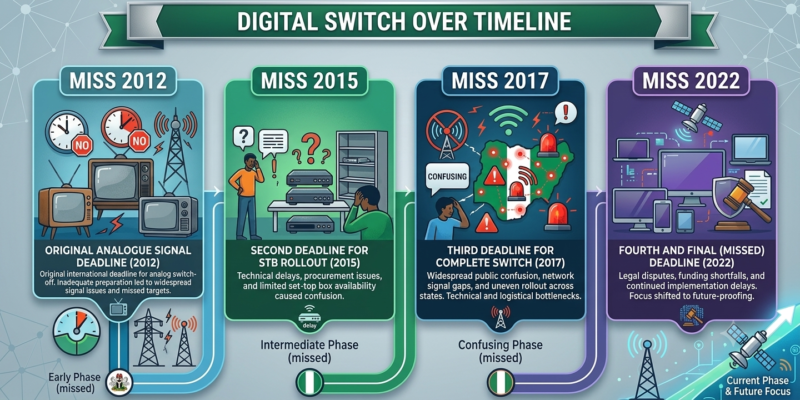
Nigeria has been trying to switch from analogue to digital broadcasting for nearly two decades, and the story of how that transition keeps stalling reads less like a policy failure and more like a recurring national habit. Since 2012, the country has missed four major Digital Switch-Over (DSO) deadlines, each time with fresh promises, new committees, and the same pile of unresolved problems waiting on the other side.
The initiative was formally adopted in 2008, when the National Broadcasting Commission (NBC) was tasked with leading the transition, with the promise that digital broadcasting would deliver sharper signals, expand access to channels, and free up valuable spectrum for telecommunications. What followed instead was a long, expensive lesson in how not to execute a national infrastructure project.
The first deadline Nigeria missed was June 17, 2012 ,a date the Federal Government itself had chosen, three years ahead of the International Telecommunication Union’s own global mandate. In 2008, the government inaugurated a Presidential Advisory Committee on transition from analogue to digital broadcasting. The committee submitted its recommendations, but for what many stakeholders described as a lack of political will, the government kept silent on the report for three years and failed to release a white paper. The deadline came and went without a single transmitter switched over.
A Nigerian Engineer is Building AI Systems to Tackle Election Fraud and Tax Leakages
The second missed deadline was June 17, 2015, the ITU’s official global switch-off date. After 2012, the government quickly inaugurated a 14-man team called Digiteam Nigeria to chase the new target, but for what industry sources described as a lack of trust between the government and broadcasters, Nigeria failed again, joining 51 other African countries that did not meet the June 2015 deadline. The consequence was not just embarrassment. Broadcast companies that had invested in anticipation of the switch began haemorrhaging. The layoffs at TVC, the closure of DAARSAT and ACTV were cited as direct results of investments made based on the proposed switchover that never materialised.
The third deadline was June 17, 2017. Nigeria had appealed to the ITU for an extension and received it, using the time to begin a phased rollout starting in Jos and Abuja. Despite efforts by the NBC to actualise the feat, the target was missed again. The switchover that was supposed to cascade nationally stalled at a handful of cities, with funding gaps and political inconsistencies slowing everything down.
The fourth missed deadline was June 2019. Nigerians were promised that June 2019 would not pass them by, but the target was missed for the fourth consecutive time, causing many concerned Nigerians to apparently lose hope. At this point, the pattern was undeniable ,not a sequence of bad luck, but a systemic failure of coordination, funding, and institutional follow-through.
Countries including Mauritius, Rwanda, Tanzania, Kenya, Malawi, Botswana, and Namibia have all successfully completed the DSO process in the region, while almost all of Europe has transitioned, with Luxembourg completing its switchover as far back as 2006. Nigeria, meanwhile, is now eyeing June 17, 2026 as its next target date. Whether this one holds depends on whether the country has finally learned from four rounds of the same mistake.