



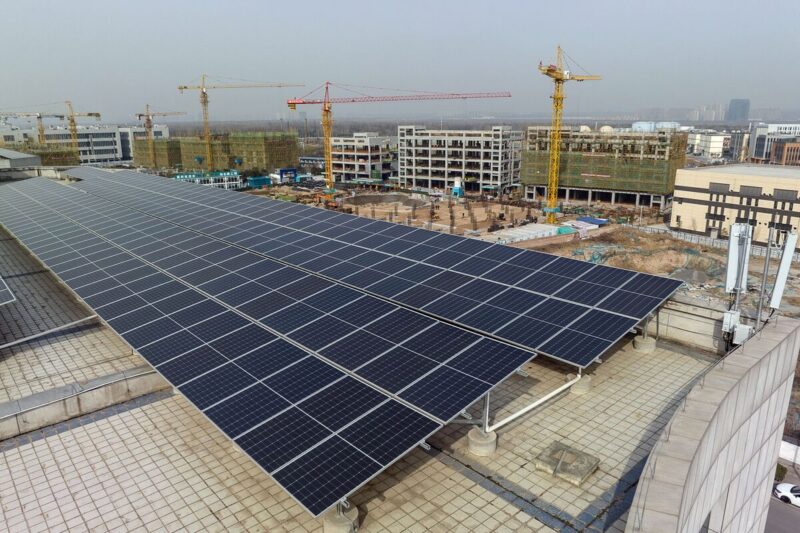
Africa has long been described as the world’s most sun-drenched continent sitting in the dark. That paradox is finally beginning to unravel ,and China is playing a central role in dismantling it. In April 2026, China’s exports of solar cells and panels to African countries climbed 83% year-on-year to 123,787 metric tons, according to Chinese customs data released by Reuters. It is one of the most striking data points in a continent-wide clean energy story that has been quietly building momentum for years, and it signals something far deeper than a temporary trade shift.
To understand why this surge matters, you have to start with the scale of the problem Africa is trying to solve. Around 563 million people across the continent still lack access to electricity, the vast majority of them in rural and peri-urban communities across sub-Saharan Africa. Central Africa sits at just 28% electrification, while the broader sub-Saharan region has been locked in a painful cycle where population growth consistently outpaces grid expansion. For decades, the promise of Africa’s energy future leaned heavily on large hydropower projects and fossil gas infrastructure, both expensive, slow to build, and increasingly out of step with where global capital is flowing.
Solar has changed that calculation almost overnight. Africa added 54% more solar capacity in 2025 than the year before, the highest annual deployment the continent has ever recorded, according to the Global Solar Council’s Africa Market Outlook. South Africa led the charge, adding 1.6 gigawatts of new capacity, followed by Nigeria at 803 megawatts and Egypt at 500 megawatts. For the first time in recorded history, renewable energy overtook coal in Africa’s electricity mix in 2025, driven in large part by the rapid influx of solar panels and the commissioning of the Grand Ethiopian Renaissance Dam, which at 5.15 gigawatts is now the continent’s largest hydroelectric project.
What makes China’s role in this transformation so significant is the sheer scale and affordability of what it produces. Chinese firms manufacture roughly 86% of the world’s solar panels, and their pricing carries a decisive edge,premium Chinese panels typically cost 20% to 30% less than comparable products from other Asian exporters. As Western markets have pulled back from Chinese solar imports with the United States and Europe erecting tariff walls that have redirected Chinese supply flows, Africa has emerged as a natural alternative destination. The top African buyers in April 2026 were South Africa, which increased purchases by 81.4% on a volume basis, and the Democratic Republic of Congo, a country with one of the lowest electrification rates on Earth, where imports surged an extraordinary 482% to nearly 18,000 metric tons.
Zoom out to the annual picture and the trend is just as compelling. Africa imported 18.8 gigawatts of Chinese solar panels in 2025, up from 12.7 gigawatts in 2024 ,a 48% increase, according to the energy think tank Ember. That combined volume exceeds three times the capacity of the Grand Ethiopian Renaissance Dam. Between 2020 and 2025, Africa invested $34 billion in clean power technologies, with 52% of that directed toward solar. The continent’s solar panel imports have effectively tripled outside of South Africa in just two years, rising from 3,734 megawatts in the twelve months to June 2023 to 11,248 megawatts in the twelve months to June 2025. Ember’s researchers noted that this is not a single-month anomaly or an inventory spike but evidence of a structural, sustained shift in demand.
The drivers behind this acceleration are layered. Governments across the continent have become more serious about energy reform, Nigeria’s Electrification Programme, for instance, has helped more than 5.9 million Nigerians access electricity through mini-grids and rooftop solar deployments since 2018. Countries that were once almost entirely dependent on fossil gas, including Egypt and Algeria, are pivoting hard. Egypt more than doubled its Chinese panel imports in 2025 to 2.3 gigawatts. Algeria increased its imports sixfold, from 0.35 gigawatts to 2.1 gigawatts. Both countries have long relied on gas for domestic power generation and are now hedging aggressively against the cost and emissions exposure that dependency creates.
There is also a geopolitical dimension to what is happening. China is not merely exporting hardware. Chinese companies are deepening supply chains across African markets, building relationships with local governments and developers, and positioning themselves as long-term partners in Africa’s infrastructure buildout. As Cynthia Angweya-Muhati, acting CEO of the Kenya Renewable Energy Association, put it, Chinese companies are the main drivers in Africa’s green transition and are actively investing in building robust supply chains within the continent’s green energy ecosystem. That kind of embedded presence is difficult for Western competitors , who have largely retreated behind tariff walls rather than engaging aggressively in frontier markets, to replicate quickly.
SEE ALSO :Nigeria, 3 African Countries to Get 1,500 US-Made Base Stations
UDespite all this progress, Africa’s solar story is still in its early chapters. Solar accounted for less than 4% of Africa’s electricity mix in 2025, even as the continent sits on some of the most intense and consistent solar irradiation anywhere on the planet. The International Energy Agency notes that new electricity connections in sub-Saharan Africa rose to 6.8 million in 2024, but population growth in areas without access offset much of that gain. Financing gaps, underdeveloped transmission networks, and limited local manufacturing capacity ,Morocco and South Africa together produce only about 2 gigawatts of panels annually, remain structural headwinds. Africa’s goal of reaching 300 gigawatts of renewable energy capacity by 2030, set under the Africa Renewable Energy Initiative, would require a dramatic acceleration in both installation and grid infrastructure. Still, the 83% jump in Chinese solar exports to Africa in a single month captures something real: a continent that has historically been overlooked in the global clean energy story is beginning to claim its place in it. The sunlight was always there.
The affordability, the policy will, and the supply chain are finally catching up. Whether Africa can convert these panel imports into durable electricity access, connecting households, powering schools, and anchoring industries,will depend on more than what arrives at its ports.
But what is arriving at those ports, in ever-larger quantities, is a foundation worth building on.