




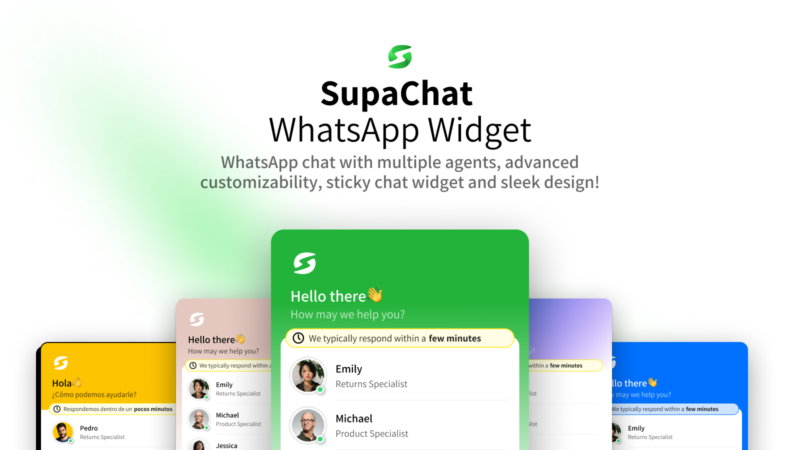
South African startup SupaChat Global is on a mission to ensure that no business, regardless of size or budget, ever loses a customer simply because no one was available to respond. The Johannesburg-based company enables businesses to deploy AI agents trained on their own products, pricing, brand voice, and customer service parameters, engaging customers across WhatsApp, web, Facebook, and Instagram, in multiple languages, around the clock.
Founded last year, SupaChat describes itself as the “deployment layer” for AI in Africa. It is a deliberately grounded framing, one that speaks directly to the gap between the promise of artificial intelligence and the reality of running a business on the ground in a market like South Africa. “Big Tech builds the models and global SaaS builds the tools, but someone has to make AI actually work for a business operating on the ground. That is what we do,” founder and CEO Lindile Ndube told Disrupt Africa.
SEE ALSO:ChatGPT Hits 1 Billion Monthly Users, Sets Fastest Growth Record in App History
The startup has built its proposition around three core products. Thuso is a support and commerce agent for WhatsApp and web chat that answers questions, closes sales, and books appointments 24 hours a day, seven days a week. For the overwhelming majority of South African SMEs that depend on WhatsApp as their primary customer engagement channel, Thuso effectively functions as a permanent, always-available sales and support representative, one that absorbs every inquiry, qualifies every lead, and never goes offline.
Then there is Khulu, a social media manager that posts content and automatically replies to comments and DMs across Facebook, Instagram, and TikTok. Maintaining a consistent, responsive brand presence across multiple social platforms is a resource-intensive task that most small businesses struggle to sustain. Khulu is designed to handle that burden entirely, ensuring that a comment or DM at any hour receives a prompt, on-brand response rather than silence. Completing the core suite is Azi, an omnichannel data analyst that reads signals from radio, social media, and chat channels and translates them into actionable intelligence for the business.
What distinguishes SupaChat’s approach is not just the breadth of its product lines but the philosophy behind how they are sold. Every product is offered à la carte, allowing businesses to start with a single agent and add others as they grow, rather than being locked into expensive bundles designed for enterprise procurement cycles. It is a deliberately accessible model for a market where the businesses that need automation the most are often the ones least able to absorb large upfront commitments.
The company also offers SupaChat Creators, which lets brands enlist influencers and plug their content into AI-powered auto-replies, combining authentic reach with always-on engagement; a Marketplace that enables businesses to sell products securely through chat with payments and fulfilment handled end-to-end; and SupaChat Media, which routes programmatic advertising clicks directly into live SupaChat conversations, eliminating the dead-end journeys that see interested buyers land on static pages with no immediate path to engagement.
The client testimonials SupaChat has accumulated already punch above the startup’s age. Pratiksha Jekison of MTN South Africa described the company’s work as groundbreaking, crediting the team’s deep understanding of user experience, campaign strategy, and innovation at scale. Similar endorsements have come from Unilever SA, Primedia OOH, and Ultimate Media, names that reflect both the commercial credibility SupaChat has built and the scale of enterprise appetite for what it is offering.
Yet the company is careful to anchor its identity in the opposite direction, in the vast majority of South African businesses that do not have enterprise resources. SupaChat’s argument is that most businesses are falling behind not because of what they cannot do, but because of what they cannot afford to build, the CRM, the automation, the always-on engagement layer that was designed for organisations with budgets most businesses will never see. The company’s answer is to democratise that infrastructure, one deployment at a time.
That ambition sits within a continent-wide AI momentum that is accelerating rapidly. More than 2,400 AI companies are now active across Africa, with over two billion dollars invested into AI-driven ventures, positioning the continent as an increasingly dynamic player in the global agentic AI economy. South Africa, with its relatively mature digital infrastructure, its mobile-first consumer base, and the dominance of WhatsApp as a commercial communication channel, is a natural proving ground for exactly the kind of deployment-layer model SupaChat is building.
For businesses that have watched leads go cold while they slept, or lost customers to competitors who simply responded faster, SupaChat’s pitch is refreshingly concrete: the infrastructure to never miss a lead is no longer the exclusive preserve of companies with the budget to build it.






Interesting how AI is becoming such a big player for businesses. Do you think it really helps with lead generation?