


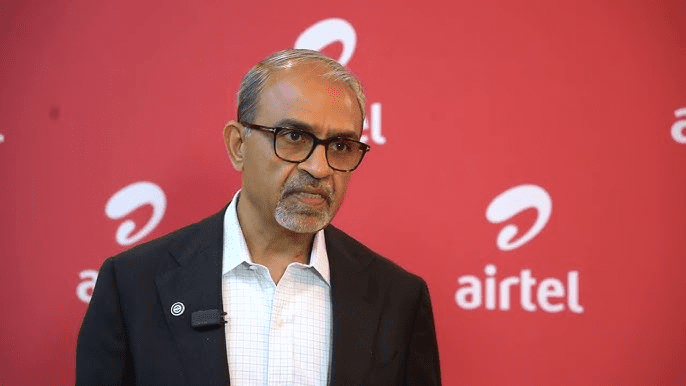
Sunil Taldar, the Chief Executive Officer of Airtel Africa, has walked away with a total compensation package worth approximately ₦2.25 billion for the financial year ended March 2025, including a performance bonus of around ₦1.08 billion, as the pan-African telecoms giant delivered one of its most impressive financial performances in years.
According to Airtel Africa’s official remuneration report for the year, Taldar received an annual bonus of $685,900, with $457,300 paid in cash and the remaining $228,600 deferred into company shares over a two-year period. His total remuneration for the year came to $1.422 million, covering his base salary of $570,000 alongside benefits, pension contributions, and the bonus. At the current exchange rate of approximately ₦1,580 to the dollar, the bonus alone translates to over ₦1 billion, while his full package converts to well above ₦2 billion, a figure that underlines just how richly the market has rewarded his first full year at the helm.
READ ALSO:Airtel Africa Launches $50 Million Share Buyback Program
The bonus was tied to a rigorous performance scorecard covering four key metrics: net revenue growth, underlying EBITDA performance, operating free cash flow, and personal objectives including gender diversity at senior management level and internal audit compliance scores. The committee awarded Taldar 80.3% of his maximum bonus opportunity after the company exceeded its most ambitious revenue targets and posted strong results across the other financial measures.
The payout comes on the back of a stellar run for the Airtel Africa group. The company reported a 147.4% surge in profit after tax to $813 million for its full financial year 2026, with revenue rising 29.5% to $6.41 billion, driven by strong growth in data and mobile money services. The customer base expanded 10.5% to 183.5 million, with data customers increasing 14.8%.
Nigeria was the engine room of that growth. Airtel recorded particularly strong performance in Nigeria, where revenue rose 52.9% to $1.60 billion and underlying EBITDA jumped 77% to $922 million. Data revenue in Nigeria surged 69.8% and the EBITDA margin improved sharply to 57.5% from 49.7% in the prior year. Those are numbers that would make any telecommunications board sit up, and they speak to how the belated Nigerian telecoms tariff adjustments, long resisted but ultimately approved, unlocked a wave of revenue that had been sitting dormant in the market.
Taldar, who only assumed the CEO role in July 2024 after joining Airtel Africa in 2023 as Director of Transformation, was candid about what drove the numbers. He said the company achieved strong 24% growth in constant currency revenues in FY26, with reported currency revenues rising 29.5% to $6,415 million, attributing it to attractive industry fundamentals, focused operational execution, and tariff adjustments in Nigeria alongside macroeconomic tailwinds. He also pointed to the role of technology, saying that the adoption of digital platforms and AI had been pivotal in unlocking growth and driving efficiencies across the group.
Taldar brings more than 30 years of experience in fast-moving consumer goods and telecoms to the role, including deep exposure to markets in China, India, Indonesia, and Singapore. He is widely credited as a pioneering force behind the mobile revolution in India, having helped transform Bharti Airtel’s business model to make affordable voice and data services accessible to ordinary consumers at scale. That background is now clearly bearing fruit in Africa, where Airtel operates across 14 countries ranging from Nigeria and Kenya to Tanzania, Rwanda, and the Democratic Republic of Congo.
Beyond the headline profit figure, Airtel Money continued to build its position as a major growth driver for the group. The Airtel Money customer base increased 21.3% year on year to 54.1 million, with transacting customers growing 74% in FY26. The annualised total processed value grew 49% to over $215 billion in reported currency in the fourth quarter of the financial year. The mobile money business now contributes more than a fifth of group revenue, a share that has been steadily climbing as Airtel deepens its financial services push across East and Francophone Africa.
East Africa, which includes Kenya, Uganda, Tanzania, Zambia, Malawi, and Rwanda, posted revenue of $3.02 billion, more than Nigeria and Francophone Africa combined, making it Airtel’s largest revenue region by a comfortable margin. The performance from that cluster of markets demonstrates the group’s geographical diversification and its ability to generate growth even outside its historically dominant Nigerian market.
One complication looming over the otherwise clean narrative is the delayed Airtel Money IPO. Airtel Africa had been targeting a listing of its mobile money unit in the first half of 2026, but the company has now pushed that timeline to the second half of the year, citing market conditions following recent geopolitical developments. The company said it has made good progress and remains committed to the listing when conditions allow.
That delay has consequences beyond just timing. TPG and Mastercard, which invested in Airtel Money back in 2021, had secured put options allowing them to sell back their stakes if no IPO materialised within a defined window. Those options were extended in 2025 and now tie the group to a rough mid-2026 deadline, adding a layer of urgency to a listing that the market has been waiting on for years.
On operational infrastructure, the company rolled out more than 3,250 new sites during the year and expanded its fibre network by around 3,200 kilometres to 81,900 kilometres, reinforcing the physical backbone that supports both its voice and data services as demand accelerates.
Looking ahead, the company said it remained positive on medium-term growth opportunities across its markets but warned that rising energy costs linked to geopolitical developments in the Middle East could increase cost inflation and place pressure on EBITDA margins in the near term.
For now, the story is one of a telecom giant firing on all cylinders, a CEO collecting a well-earned reward for his first full year in charge, and an Africa-focused business proving that the continent’s digital and financial inclusion story still has a great deal of upside left to run.