


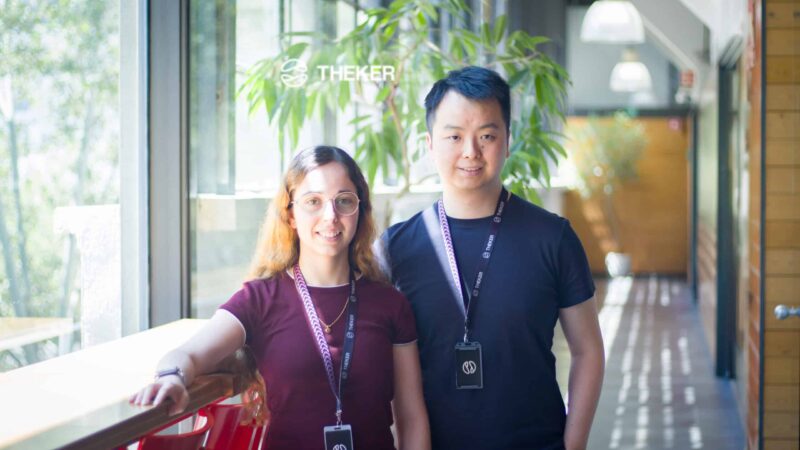
Theker, a robotics startup building AI-powered industrial machines that are not limited to a single task, has raised $85 million in fresh funding as investor interest in adaptable factory automation continues to accelerate.
The round positions the company among a growing wave of robotics startups attempting to move beyond traditional single-function industrial robot systems typically programmed for repetitive, narrowly defined tasks on production lines. Instead, Theker is developing what it describes as more flexible machines capable of handling varied processes within factory environments without being retrained for each specific job.
The funding comes at a time when global manufacturers are increasingly under pressure from labor shortages, rising production costs, and the need for faster, more flexible manufacturing systems. These challenges are pushing the robotics industry toward systems that can adapt across workflows rather than operate in isolated functions.
A Shift From “Specialized Robots” to General Industrial Intelligence
Historically, factory automation has relied on highly specialized machines built for precision and repetition such as robotic arms dedicated to welding, packaging, or assembly. While efficient, these systems are expensive to reconfigure and often lack flexibility when production needs change.
Theker’s approach reflects a broader industry shift toward general-purpose robotics, where AI models and perception systems allow machines to interpret environments and switch between tasks more dynamically. This mirrors the evolution seen in software AI models, where general-purpose systems are replacing narrowly trained tools.
If this approach works at scale, it could significantly reduce the need for multiple dedicated machines on production floors and instead enable a smaller fleet of adaptable robots to handle diverse tasks.
SEE ALSO: Equal AI raises $30M to Automate Call Screening in India
Industry Implications: Why This Round Matters
The $85 million raise signals that investors are no longer betting only on humanoid robots or highly specialized industrial systems. Instead, capital is flowing toward platforms that aim to unify automation across entire factory operations.
This shift could reshape how manufacturing companies think about automation investment. Rather than purchasing separate robots for each task, factories may begin adopting integrated systems capable of reconfiguring themselves through software updates and AI-driven decision-making.
For manufacturers, this could mean:
-
Lower long-term automation costs
-
Faster adaptation to changing production needs
-
Reduced downtime when switching product lines
-
Increased reliance on AI-driven operational systems
However, it also introduces new challenges around reliability, safety certification, and integration with existing industrial infrastructure.
What to expect
The robotics industry is now entering a more competitive and experimental phase, and several trends are likely to emerge:
-
Rise of “generalist robots”: More startups will attempt to build flexible machines rather than task-specific automation tools.
-
Factory AI integration: Robotics will increasingly rely on AI systems that coordinate multiple machines rather than operating in isolation.
-
Enterprise hesitation and pilots: Despite strong funding, large manufacturers may initially deploy these systems in limited environments before full-scale adoption.
-
Consolidation pressure: As the space matures, smaller robotics startups may be acquired by industrial giants seeking to integrate AI capabilities quickly.
Summary
Theker’s funding highlights a fundamental transition in robotics: from machines that execute predefined instructions to systems that can interpret, adapt, and operate across multiple industrial tasks.
If successful, this shift could mark the beginning of a new phase in manufacturing where automation is no longer a collection of specialized tools, but a unified intelligent layer powering entire production environments.