




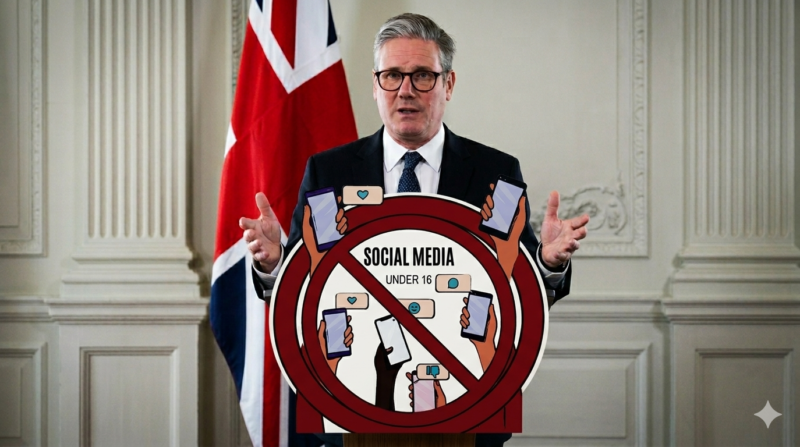
The United Kingdom has officially crossed what Prime Minister Keir Starmer is calling a line in the sand. On Monday, June 15, 2026, the British government confirmed a sweeping ban on social media access for anyone under the age of 16, and almost immediately, the world’s biggest tech companies pushed back hard.
Starmer made the announcement at a press conference at his Downing Street residence, declaring that tech giants had their chance and failed, and that the government was stepping in to protect children and set a new normal for future generations. The legislation is expected to pass before the end of this year, with enforcement beginning in spring 2027.
ALSO READ: United Kingdom Bans Children Under 16 from Social Media, Law Takes Effect in 2027
The ban covers a wide range of platforms including Snapchat, TikTok, YouTube, Instagram, Facebook and X, though YouTube Kids and messaging services like WhatsApp and Signal are excluded. Starmer also made clear that enforcement action would be directed at the tech companies themselves, not at the children who might try to find workarounds.
The response from Silicon Valley was swift and predictable. YouTube warned that blanket bans push children out of curated, supervised, beneficial environments and toward anonymous, less safe services. Meta echoed those concerns, arguing that such restrictions risk isolating teenagers from online communities and information, potentially driving them toward unregulated alternatives. The social media giant insisted that any age-based restrictions must be backed by solid age verification systems to have any real effect.
That argument cuts both ways. Meta has already introduced Teen Accounts with built-in safety profiles automatically applied to users under 18, a move the company clearly hopes demonstrates some degree of good faith. But the British government is not convinced. Technology Secretary Liz Kendall was direct in her assessment, stating that tech companies have had countless opportunities to keep children safe, yet have consistently failed to act.
The UK’s approach goes further than Australia’s landmark ban, which came into effect in December 2025 and served as the primary blueprint for what Starmer’s government is now proposing. Beyond blocking standard social media platforms, the new legislation will restrict livestreaming, ban strangers from communicating with children on gaming platforms, and require so-called AI romantic companion chatbots to enforce a minimum age of 18. The government also announced plans to look more closely at overnight curfews and breaks in infinite scrolling for under-18s, with further detail expected in July.
A government survey found that nine in ten parents supported a minimum age of 16 for social media access, a figure Starmer cited as a key driver behind the decision. Yet experts are already flagging the practical difficulties of making the ban stick. VPNs, borrowed accounts, fake dates of birth and shared family devices could all complicate enforcement. Privacy campaigners have also raised concerns, noting that effective age verification often requires collecting more sensitive personal data from users, creating a tension between child protection and digital privacy.
Ofcom, the UK’s tech regulator, will be responsible for drafting the detailed enforcement rules and publishing a clear strategy for holding platforms accountable. The tech companies will almost certainly lobby hard against the restrictions. But for the first time in a long while, the British government appears to be in no mood to negotiate.