


Chinese artificial intelligence startup Moonshot AI reportedly relies on computing capacity equivalent to around 20,000 Nvidia chips through an agreement with Alibaba, highlighting China’s continued dependence on US semiconductor technology despite years of export restrictions.
According to a Bloomberg report citing people familiar with the arrangement, the computing resources support Moonshot’s Kimi AI models, including its recently launched Kimi K3 model, which has drawn international attention for matching or outperforming several leading AI systems on key performance benchmarks.
Moonshot declined to comment on the reported agreement. Nvidia also declined to comment.
Alibaba Powers a Key Part of Moonshot’s AI Infrastructure
People familiar with the matter said Alibaba is one of Moonshot’s largest investors and encourages portfolio companies to use its cloud infrastructure. The reported agreement provides Moonshot with a significant share of the computing power needed to train and operate its AI models.
The relationship is notable because the two companies also compete in China’s fast-growing AI market. While Alibaba continues to develop its Qwen family of AI models, Moonshot’s Kimi K3 has recently outperformed several Qwen models across multiple industry benchmarks.
The report says the computing capacity is based on Nvidia’s Hopper architecture rather than the company’s latest Blackwell chips. Although sources claimed the agreement involves H200 processors, Alibaba disputed that claim and said reports that it supplied H200 chips to Moonshot are “completely groundless.” The company did not comment on which Nvidia chips support the arrangement.
US Export Controls Remain in Focus
The report comes as US officials continue to scrutinize China’s access to advanced AI hardware.
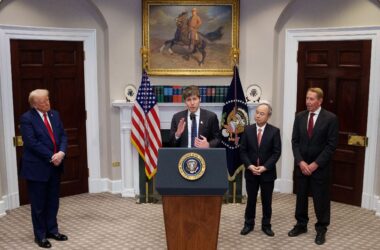
Last week, White House technology adviser Michael Kratsios alleged that Moonshot had accessed restricted Nvidia Blackwell chips through third parties in Southeast Asia. He also claimed the company may have used rented computing resources outside China, an approach that can be legal under certain circumstances depending on how the services are provided.
Bloomberg also reported that a person familiar with Moonshot’s procurement strategy confirmed the company has access to Blackwell computing resources through Southeast Asia. However, it remains unclear whether those resources come from legal cloud rental agreements or direct hardware purchases that would violate US export controls.
China’s AI Progress Still Depends on Nvidia
Moonshot’s rapid rise has fueled debate over whether US export restrictions are slowing China’s AI development as intended. Kimi K3 has demonstrated that Chinese AI companies continue to narrow the performance gap with leading US developers despite limited access to the latest hardware.
At the same time, the reported Alibaba agreement suggests Nvidia technology remains central to China’s AI ecosystem. Even as Beijing promotes domestic alternatives from companies such as Huawei, many of China’s leading AI developers still rely on Nvidia-powered infrastructure to train and deploy advanced models.
The latest report underscores a broader reality facing the global AI industry. While governments continue to tighten controls on advanced semiconductors, demand for Nvidia’s AI chips remains strong, making them a critical part of AI development on both sides of the US-China technology divide.