




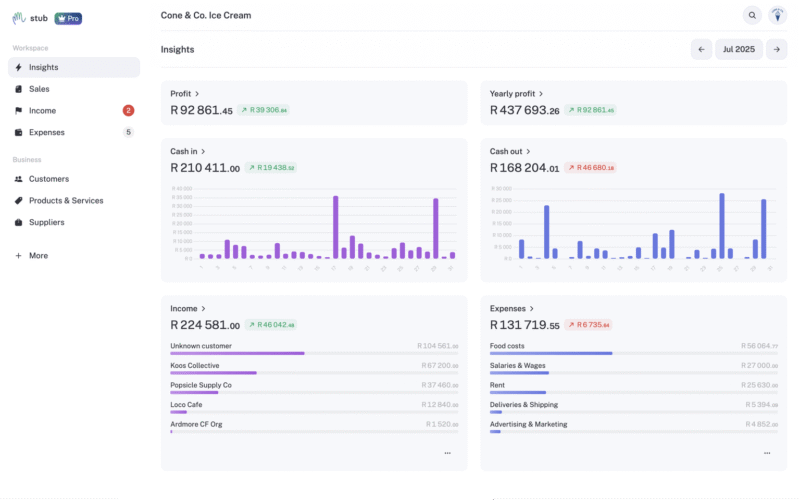
South African fintech startup stub has unveiled an artificial intelligence-native accounting platform specifically designed for everyday entrepreneurs and micro-business owners who have historically struggled with accounting software built by and for established financial services professionals.
The platform arrives at a critical juncture when small business owners across Africa increasingly seek digital tools that match how they actually operate their businesses rather than conform to rigid accounting frameworks.
ALSO READ:Apple Opens iPhone App Ecosystem in Brazil, Allowing Alternative App Stores and External Payments
Founded in 2023, stub offers accessible tools for sending invoices, managing quotes, tracking payments and monitoring cashflow with underlying functionality including a full double-entry ledger and customizable chart of accounts that ensures financial records remain genuine and compliant with regulatory standards. The platform’s architecture leverages artificial intelligence to automate manual work, categorize transactions, reconcile against linked bank feeds and surface actionable business insights, allowing entrepreneurs to focus their limited time on running their operations rather than wrestling with administrative paperwork.
Tayla Dandridge, co-founder and chief executive officer of stub, explained the founding insight emerged directly from her professional experience in financial services. Having worked extensively with small and micro-business clients throughout her career, she consistently observed that traditional accounting platforms solved the wrong problem. These systems were built for accountants and established small and medium-sized enterprises but proved prohibitively complex, expensive and disconnected from how sole proprietors, informal traders and service entrepreneurs actually manage their daily operations. The real competitive threat for stub’s target market isn’t another software platform at all but rather spreadsheets, WhatsApp conversations and shoebox record-keeping methods that characterize informal financial management across the continent.
The startup identified a critical market gap at the bottom of the income pyramid where millions of micro-entrepreneurs and small business owners remain completely unserved by traditional accounting software infrastructure. This positioning became critical to stub’s growth strategy, which relied initially on bootstrapping before securing support from strategic angel investors who recognized the market opportunity.
Stub’s expansion has accelerated substantially through partnerships that positioned the platform within existing networks trusted by entrepreneurs. The company’s first major partnership involved powering iKhokha’s iK Accounting product, an anchor relationship that introduced significant numbers of small businesses to stub’s platform. The startup subsequently secured direct integration with Capitec, South Africa’s largest bank by customer count, providing simple accounting tools to entrepreneurs and side-hustlers within one of the country’s most extensive financial institution networks. Most recently, stub announced direct app integration with Yoco, the payments platform serving more than 200,000 independent business owners across South Africa.
Dandridge noted that progressing from a single anchor partnership to a direct bank integration to collaborating with a major payments platform within eighteen months represents a meaningful milestone. More importantly, these partnerships create access to financial management tooling that numerous entrepreneurs have previously lacked entirely. The user base has expanded dramatically, with stub supporting nearly 10,000 businesses across its platform, representing a 150 percent increase from approximately 4,000 entrepreneurs seven months prior. Signups have compounded quarterly, growing from several hundred in 2023 to over 1,800 in a single quarter during 2026. The strongest customer concentrations emerge in Cape Town, Johannesburg, Pretoria and Durban, with the customer base predominantly comprising tuck shops, informal taverns, fast food outlets, salons, independent cafés, consultants and service-based entrepreneurs who operate at the foundation of South Africa’s economy.