




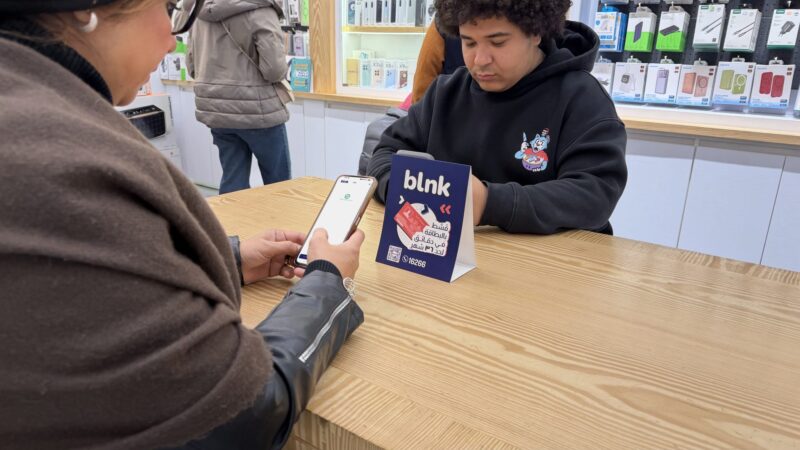
Egyptian fintech startup Blnk has closed a $37.1 million funding round as it doubles down on its mission to bring formal credit access to millions of Egyptians who have long been ignored by traditional banks. The raise is a mix of equity and debt, and it comes at a time when consumer lending in Africa’s most populous Arab country is growing fast but still failing to reach most of the population.
The funding includes a $12.5 million Series A equity round led by Algebra Ventures, with participation from SANAD Fund for MSME, Endeavor Catalyst, and existing investor Emirates International Investment Company. Alongside the equity, Blnk secured $24.6 million in local currency debt facilities from banks and non-bank financial institutions, including the National Bank of Egypt, Suez Canal Bank, and Bank Al Baraka Egypt.
SEE ALSO: Amazon Prime Launches in South Africa for Under $4 a Month
Founded in 2021 by Amr Sultan and Tarek Elsheikh, Blnk provides point-of-sale consumer loans through a network of more than 3,000 merchants across Egypt, allowing customers to finance purchases ranging from electronics and furniture to automotive services, with repayment terms spanning 6 to 36 months. What separates Blnk from the growing crowd of buy-now-pay-later providers in the market is who it actually lends to. While competitors such as valU, Shahry, Souhoola, and Contact Credit offer short-term installment plans to consumers who already have access to formal credit products, Blnk focuses on instant consumer financing at the point of sale for people who have never borrowed before in the formal system.
The scale of the problem Blnk is trying to solve is hard to overstate. As of June 2025, about 16.7 million Egyptian adults had no formal access to credit and other banking services. These are people who cannot walk into a bank and qualify for a loan, not because they are incapable of repaying, but because they lack the paper trail that traditional lenders demand. Consumer lending products like Blnk aim to lower the entry barrier for this segment to unlock credit access faster, without requiring a formal banking relationship, proof of income, or a credit history.
To bridge that gap, Blnk uses proprietary algorithms that enable rapid underwriting and loan booking at the point of sale, applying AI to hyper-local variables. With minimal documentation and in just three minutes, consumers can access financing to purchase a wide range of products or services. The company also utilizes specialized machine learning models to provide real-time probability of default predictions, enabling instant credit decisions with risk-based pricing.
The approach is clearly working. Since completing its seed round in November 2022, Blnk has onboarded more than one million customers and built a loan portfolio surpassing EGP 1 billion. Roughly 75% of its users were previously unbanked or underserved, and over 35% are female.
The company reached profitability in 2025, supported by revenue growth of 173% year-on-year. Those are not the numbers of a company still trying to find its footing. They reflect a business that has proven its model works, and is now raising capital to scale what is already performing.
One particularly notable aspect of Blnk’s financial strategy is how it has handled currency risk. The startup has relied heavily on local-currency borrowing to fund its loan book, avoiding exposure to foreign exchange swings that have hit many businesses during Egypt’s recent devaluations.
Sultan told TechCabal that the company never relied on dollar-based venture debt financing, meaning it was not hit by the FX losses that have damaged the balance sheets of other Egyptian startups during recent currency crises.
The broader market context gives the fundraise even more weight. Egypt’s consumer finance market reached EGP 96.3 billion, or approximately $2.0 billion, in 2025, a 57.1% year-on-year increase according to the Financial Regulatory Authority.
Yet fewer than an estimated 5% of adults hold access to formal credit, and just 3.9% of women make use of credit cards or online lending tools, highlighting the disconnect between account ownership and meaningful participation in formal lending.
That gap between a booming market and widespread exclusion is exactly where Blnk sits, and where investors see room for significant upside.
Algebra Ventures managing partner Karim Hussein described Blnk as a category-defining player in Egypt’s consumer finance market, citing its ability to serve underbanked consumers while maintaining disciplined credit management.
The debt component of the raise is particularly significant, as it signals that traditional lenders are willing to fund a company whose core thesis is that the people banks typically reject are actually creditworthy when assessed correctly.
With the new capital, Blnk plans to strengthen its technological capabilities, launch a credit card programme, expand its product range, and explore new markets beyond Egypt. The planned credit card, in particular, would mark a significant step forward, allowing customers to use their credit limits outside of Blnk’s existing merchant network and turning a point-of-sale lender into something closer to a full consumer finance platform.
Egypt’s fintech sector has had a complicated few years, with currency volatility and regulatory headwinds slowing some players down. Blnk’s ability to grow revenue by 173%, hit profitability, and now close a substantial funding round in that environment says something about both the resilience of the team and the genuine depth of demand for what they are building.