




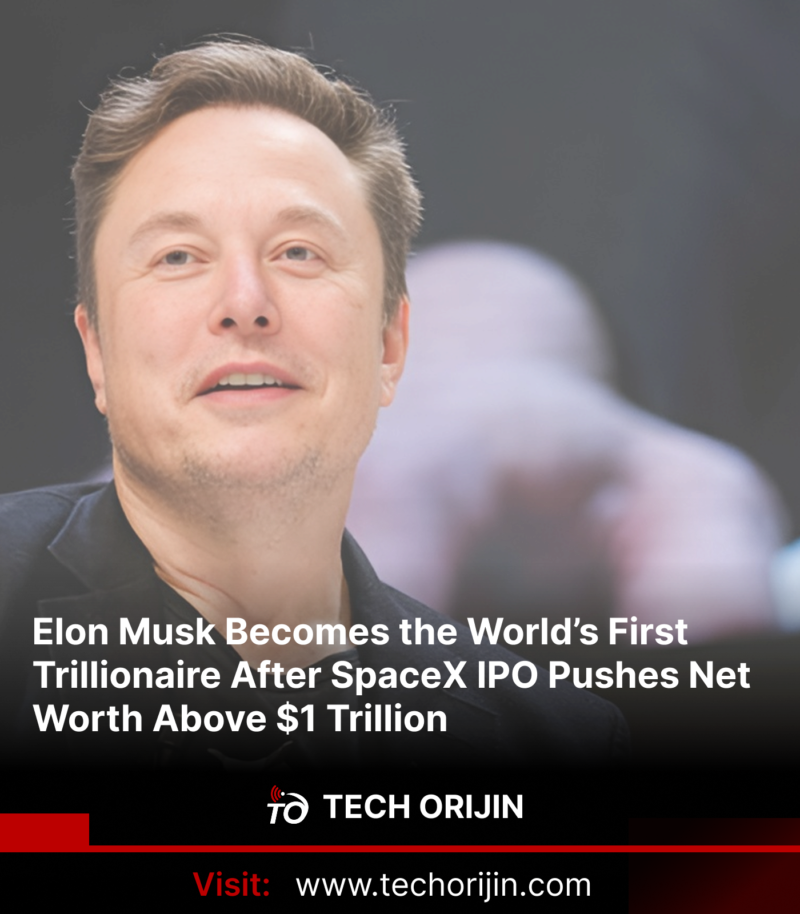
History was made on June 12, 2026. For the first time in recorded human civilization, a single individual has crossed the threshold of one trillion dollars in personal net worth. That individual is Elon Musk, the South African-born entrepreneur whose relentless ambition has reshaped the electric vehicle industry, the commercial space sector, and now the very concept of personal wealth itself. The milestone was sealed by the blockbuster public market debut of his rocket and satellite company, SpaceX, which officially began trading on the Nasdaq today under the ticker SPCX.
On June 11, 2026, SpaceX priced its IPO at $135 a share, valuing the company at $1.77 trillion. That figure, multiplied across Musk’s stake in the company, pushed his total net worth past $1 trillion, according to calculations by Reuters and Forbes based on the company’s SEC filing. No individual in recorded history has held this much wealth, not John D. Rockefeller at the height of the oil era, not Jeff Bezos at the peak of the Amazon boom, not anyone before Musk. The world now has its first trillionaire, and the implications of that fact are only beginning to sink in.
SEE ALSO:SpaceX to Put AI Data Centers in Space
The SpaceX IPO raised approximately $75 billion, ranking it as the largest initial public offering in history, shattering the previous record held by Saudi Aramco’s $26 billion debut in 2019. SpaceX offered exactly 555,555,555 shares at $135 apiece, giving the company a market value of $1.77 trillion. Only six companies in the S&P 500 are currently worth more, with Nvidia topping the list at $5.2 trillion. The scale of what SpaceX has achieved in going public is almost without comparison in financial history.
SpaceX now drives close to 80 percent of Musk’s total fortune. Per the company’s June 2026 S-1 filing, Musk holds 4.76 billion vested SpaceX shares. At $135 per share, that block alone is worth roughly $642 billion. The fuller reading of the prospectus, which includes additional share classes and vested options, brings the total SpaceX-linked wealth to $866.5 billion. Tesla, which for years served as the primary engine of his rising fortune, now accounts for roughly a quarter of his total net worth.
The net worth difference between Musk and the second-richest person on earth is staggering. Alphabet co-founder Larry Page, who ranks second on the Bloomberg Billionaires Index, is estimated to be worth around $304 billion. To put that in perspective, even the second-wealthiest person alive holds less than a third of what Musk now commands. The gap between first and second place on the global rich list has never been this wide.
For the 54-year-old Musk, the SpaceX offering comes 16 years after he took Tesla public. His voting control of SpaceX after the offering will be north of 82 percent, according to the company’s prospectus filing. Despite the enormous dilution that a public offering typically brings to a founder’s control, Musk retains an iron grip on the company’s direction and governance, which has always been central to how he operates his businesses.
The IPO document itself has drawn attention for reasons beyond the numbers. Colorful and even striking in parts, the filing contrasts sharply with the typically dry, technical prose of most IPO documents, detailing plans to use proceeds from the sale to help put men on the moon again and perhaps even Mars. SpaceX also flagged artificial intelligence as a central pillar of its future revenue ambitions, citing potential AI revenue of up to $26.5 trillion, though that depends on another ambitious goal, which is putting data centers in space, something that is not yet technologically possible.
The milestone comes amid a broader context that has made Musk a figure of both admiration and controversy. While admirers view his unfiltered style as part of his appeal, critics have accused him of wielding outsized power, raised concerns about governance at his companies, and objected to his increasingly partisan political interventions. None of that controversy, however, has slowed the trajectory of his net worth or the market’s appetite for SpaceX shares.
What this moment represents, beyond the spectacle of one person holding more wealth than most countries produce in a year, is a signal about where the world’s economic weight is shifting. The age of the billionaire, it seems, has now given way to something else entirely. The trillionaire era has begun, and Elon Musk is its first citizen. Whether that wealth will eventually serve the planetary ambitions he has long championed, from Starlink internet access in underserved regions to a human colony on Mars, remains the trillion-dollar question the world is now watching closely.