



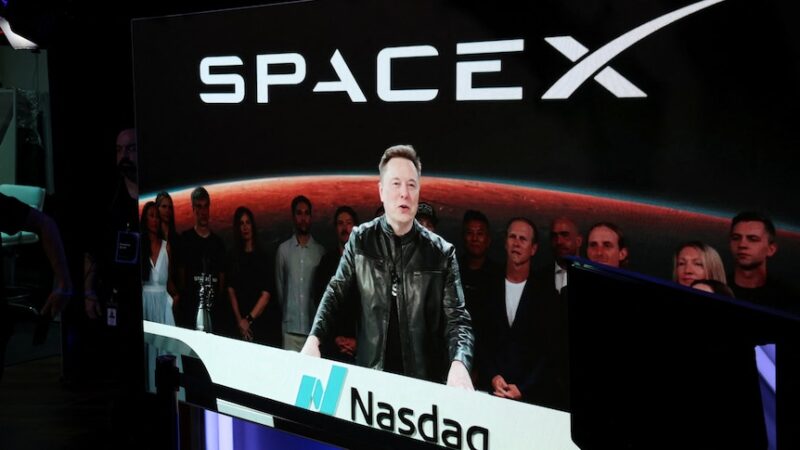
History does not announce itself with a whisper, and on June 12, 2026, it certainly did not. On a morning when Elon Musk stood at the company’s Starbase headquarters in Texas to ring the opening bell, SpaceX became a publicly traded company, and with it, Musk became the first human being to ever hold a net worth exceeding $1 trillion. It was the kind of milestone that redefines what wealth, ambition, and technological ambition can look like in a single lifetime.
SpaceX priced its IPO on Thursday, June 11, 2026 at $135 per share and debuted on the Nasdaq Stock Market under the ticker SPCX on June 12, raising $75 billion by selling more than 555 million shares, marking the largest initial public offering in history.
To appreciate how staggering that figure is, consider that when Saudi Aramco went public in 2019, then the record-holder, it raised nearly $26 billion. SpaceX nearly tripled that with a single day’s work.
READ ALSO:Elon Musk Becomes the World’s First Trillionaire After SpaceX IPO Pushes Net Worth Above $1 Trillion
The stock market’s reception was nothing short of extraordinary. Trading under the SPCX ticker on the Nasdaq, SpaceX shares rose 19% on their first day to close at $160.95, and the company ended the session valued above $2 trillion, instantly becoming one of the world’s biggest listed companies.
The first trade printed at $150, approximately 11% above the IPO price, with shares reaching an intraday high of $175.50 during the session. Reported demand exceeded $250 billion, with roughly 30% of the deal allocated to retail investors. To put that demand figure in perspective, investors placed orders for more than three times the shares available, a level of enthusiasm that speaks to how deeply the market believes in Musk’s long-term vision.
The rally lifted SpaceX’s market capitalization to approximately $2.1 trillion, making it the sixth most valuable publicly listed company in the United States. The company’s stock market debut was also timed with characteristic Musk flair: to punctuate the big day, SpaceX launched a Falcon 9 rocket in Florida about an hour before the stock market opened, delivering Starlink broadband satellites, marking the 650th flight of a Falcon 9 rocket.
For Elon Musk personally, the day meant crossing into territory no individual has ever occupied. According to the Bloomberg Billionaires Index, Musk’s net worth surged to an unprecedented $1.11 trillion following the blockbuster stock market debut, with SpaceX shares rising 19% on their first day of trading.
His closest peers among the ultra-wealthy, Google co-founders Larry Page and Sergey Brin, are worth $800 billion less than Musk combined. As recently as the summer of 2024, Musk, Bezos, and Bernard Arnault were swapping the title of world’s richest person on a near-daily basis, with net worths hovering around $200 billion. Now, not even two years later, Musk has amassed the world’s first trillion-dollar fortune, worth twice as much as Bezos and Arnault put together.
The company that took Musk to that threshold is one that touches almost every frontier of modern technology. One share of SPCX now represents the combined company spanning SpaceX’s launch business under Falcon and Starship, Starlink satellite internet, the xAI artificial intelligence lab, and X, formerly known as Twitter, which xAI acquired in 2025. This makes SpaceX far more than a rocket company. It is, effectively, an empire of technology and ambition that has reorganized itself into a publicly tradeable entity.
Beneath all the spectacle, though, the financial picture carries notable complexity. SpaceX recorded a net loss in its most recent quarter of $4.28 billion after losing $4.94 billion across the full year of 2025.
Its Starlink connectivity arm generated $3.26 billion in revenue in the latest quarter, accounting for 69% of the total company revenue. Starlink is the profitable core of the business, with $11.4 billion in 2025 revenue and a 63% adjusted EBITDA margin, the only part of the business currently making a profit. The xAI division, by contrast, incurred a $6.36 billion operating loss in 2025.
Morningstar analysts warned that SpaceX has been significantly overvalued, noting that the xAI segment poses a material threat of value destruction, and that SpaceX’s own S-1 filing explicitly stated it has a history of net losses and may not achieve profitability in the future.
Analysts at the firm cautioned that investors may find more attractive entry points once post-IPO volatility settles. That caution has not dampened the mood on Wall Street, where the company has been treated less like a traditional corporation and more like a once-in-a-generation bet on where humanity is heading.
At the IPO price of $135 per share, SpaceX was priced at approximately 94 times its 2025 revenue of $18.67 billion, a multiple that has no precedent among the world’s most valuable companies.
The market, in essence, is not buying what SpaceX is today. It is buying what the company intends to become: the infrastructure behind Mars colonization, space-based data centers, global satellite internet, and next-generation artificial intelligence.
During the opening bell ceremony, Musk told those watching: “Whoever you are watching this, SpaceX wants to be able to take you to the moon, take you to Mars, and ultimately beyond.” It was a statement that captured exactly why investors have poured their confidence into the company despite its current losses.
Few chief executives in the world can make that kind of promise and have the track record of rocket landings, orbital missions, and satellite deployments to give it even a shred of credibility.
Elon Musk is not selling any shares in the IPO and will retain 82.4% of the voting power in SpaceX post-listing, ensuring that strategic decisions about Mars colonization, AI development, and capital allocation remain under his authority. This means the company goes public on Musk’s terms, not the market’s, and investors who buy in are betting on one man’s vision as much as they are on any balance sheet.
What SpaceX’s public debut ultimately signals is not just a financial milestone but a philosophical one. The company launched in 2002 with the declared intention of making humanity a multi-planetary species. More than two decades later, it has raised $75 billion from the public in a single day, made its founder the richest person in recorded human history, and entered the global stage as one of the most valuable corporations on earth.
Whether the valuation proves justified will take years to determine. What is already certain is that the story of SpaceX’s IPO will be told for generations as the day the space age became a publicly traded reality.