




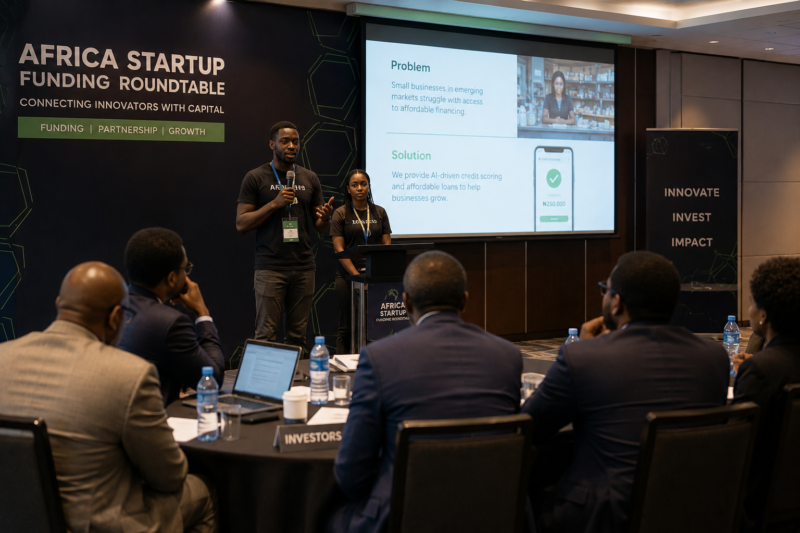
Africa’s startup ecosystem has spent much of the past decade proving that world-class technology companies can emerge from the continent. Billion-dollar fintechs, fast-growing logistics platforms, climate tech innovators and AI startups have collectively attracted billions of dollars in venture capital, transforming Africa into one of the world’s most closely watched emerging technology markets.
But the latest funding figures suggest the ecosystem is entering a new chapter, one defined less by abundant capital and more by disciplined investment.
According to recently published reports, African startups raised approximately $260 million across 38 deals during the second quarter of 2026, representing a 40% decline compared with the same period in 2025. While the headline number points to a sharp slowdown, the underlying story is far more nuanced than a simple funding slump.
Rather than signalling the decline of Africa’s innovation economy, the latest figures reflect a venture capital market that is becoming increasingly selective, with investors placing greater emphasis on sustainable business models, capital efficiency and clear paths to profitability.
For much of the last decade, venture capital rewarded startups that demonstrated rapid user acquisition and aggressive expansion, even when profitability remained years away.
That investment philosophy is changing.
Across global technology markets, investors have become increasingly cautious following higher interest rates, longer exit cycles, and reduced liquidity in public markets. Africa has not been immune to these global macroeconomic realities.
Instead of chasing growth alone, investors are now scrutinising unit economics, recurring revenue, customer retention, and operational discipline before committing capital. Founders are increasingly expected to demonstrate not only market opportunity but also how efficiently they can convert funding into sustainable businesses.
This shift is reshaping fundraising across the continent, particularly for early-stage startups that previously relied on abundant venture capital to finance rapid expansion.
Capital Is Concentrating Around Stronger Companies
The funding decline does not necessarily indicate that investors have lost confidence in African technology.
Rather, it suggests that capital is becoming increasingly concentrated.
Investors are writing fewer cheques but directing larger investments towards startups with proven traction, experienced leadership teams and established revenue streams. Companies operating in regulated sectors such as financial technology, enterprise software, digital infrastructure and climate technology continue to attract investor interest, while businesses with weaker fundamentals are finding fundraising significantly more challenging.
This trend mirrors developments across North America, Europe and Asia, where venture capital firms have also become more selective in deploying capital.
SEE ALSO: Google Unveils 5 AI Initiatives to Boost Africa’s Digital Future
Fintech Remains Dominant But the Ecosystem Is Diversifying
Financial technology continues to account for a significant share of venture investment across Africa.
Payments, cross-border remittances, embedded finance and digital banking remain attractive to investors because they address longstanding structural gaps in financial inclusion while offering scalable business models.
However, the investment landscape is becoming increasingly diversified.
Climate technology, renewable energy, agricultural technology, logistics, enterprise software, artificial intelligence, health technology and business infrastructure are gradually attracting greater investor attention as governments and corporations accelerate digital transformation initiatives.
This diversification represents an important milestone for Africa’s innovation ecosystem, reducing dependence on a single sector and creating broader opportunities for entrepreneurs.
Venture Debt Is Becoming Part of the Conversation
Another notable development is the growing adoption of venture debt and alternative financing structures.
Instead of relying exclusively on equity financing, an increasing number of startups are supplementing fundraising with debt facilities, revenue-based financing and strategic partnerships.
For founders, this can reduce equity dilution while providing access to growth capital. For investors, it reflects greater confidence in startups capable of generating predictable revenues and servicing debt obligations.
The emergence of these financing models suggests Africa’s capital markets are gradually becoming more sophisticated, offering founders more options than traditional venture capital alone.
Nigeria Continues to Play a Central Role
Despite tighter funding conditions, Nigeria remains one of Africa’s most influential startup ecosystems.
The country’s fintech companies continue expanding internationally through acquisitions, regulatory approvals and new product launches rather than relying solely on successive fundraising rounds.
This evolution reflects a broader trend across the continent, where scale is increasingly being achieved through operational execution, strategic partnerships and acquisitions instead of capital-intensive expansion.
For investors, companies demonstrating disciplined execution may now present more attractive opportunities than startups pursuing growth without clear economic fundamentals.
A Healthier Investment Environment?
While a 40% funding decline may initially appear alarming, many industry observers argue that the current environment could ultimately strengthen Africa’s technology ecosystem.
Periods of abundant capital often encourage excessive valuations, unsustainable spending, and business models dependent on continuous fundraising.
A more disciplined investment climate rewards companies capable of solving real problems, generating sustainable revenue and building resilient businesses that can withstand economic uncertainty.
History suggests that some of the world’s most enduring technology companies were built during periods when capital was scarce rather than plentiful.
What Comes Next
Africa’s technology ecosystem is unlikely to return immediately to the record-breaking investment levels seen during the post-pandemic venture capital boom.
Instead, the continent appears to be entering a more mature phase—one where founders must demonstrate stronger execution, investors prioritise quality over quantity, and capital is allocated with greater discipline.
For entrepreneurs, the message is becoming increasingly clear: fundraising alone is no longer the benchmark for success. Sustainable growth, operational efficiency, and long-term value creation are now emerging as the defining metrics of Africa’s next generation of technology companies.
The 40% decline in second-quarter funding is therefore more than a quarterly statistic. It marks a shift in how venture capital is evaluating African innovation, one that may ultimately produce a stronger, more resilient, and globally competitive startup ecosystem.