




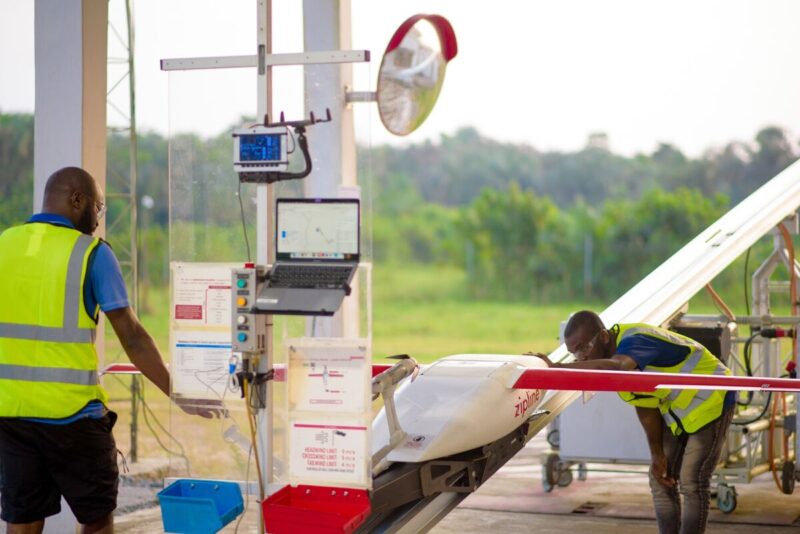
Zipline, the California based drone logistics company, has delivered more than 6.1 million vaccine doses across Kaduna, Cross River and Bayelsa states in Nigeria, and the company now says it wants to take its autonomous delivery network nationwide.
Anthonio Pinheiro, Zipline’s newly appointed Nigeria Country Director, disclosed the company’s expansion plans in a recent interview, revealing that Zipline intends to build 12 additional distribution centres across the country, growing its network from three operational hubs to 15 facilities by 2028. The move would connect up to 20,000 health facilities and extend access to essential medical commodities to nearly 100 million Nigerians, roughly half the country’s population.
Zipline first entered Nigeria in 2022, launching operations in Kaduna State before expanding into Cross River and Bayelsa. What began as a series of state level pilot programs delivering vaccines, blood and medical supplies to underserved communities has since grown into what the company now describes as the early buildout of a national healthcare logistics network. Pinheiro said the three states currently in operation serve over 1,300 health facilities and about six million people, a figure the company hopes to multiply several times over through the new expansion.
Rather than continuing to negotiate isolated deployments state by state, Zipline is pursuing a federal scale framework that would make it easier for individual states to plug into a unified, national autonomous delivery system. That shift is being backed by a broader partnership involving Nigeria’s Federal Ministry of Health and the United States government, which has supported Zipline’s expansion across five African countries through a dedicated grant initiative.
The problem Zipline is positioning itself to solve has long troubled Nigeria’s healthcare system. Rural health facilities frequently run out of vaccines, blood supplies, anti venom, malaria drugs and maternal care products, forcing patients to travel long distances only to find the medicine they need is unavailable. A 2026 study on family planning services found that 56.8 percent of rural health facilities experienced at least one contraceptive stockout within a three month period, compared to 43.2 percent in urban centres.
Zipline’s model works by centralising medical inventory at automated distribution hubs equipped with cold storage and AI powered tracking systems, then delivering supplies on demand rather than requiring hospitals to maintain large, costly stockpiles. Pinheiro described a scenario where a hospital that runs short of vaccines mid clinic can call Zipline and receive additional doses within thirty to forty five minutes. He also cited a case in which anti venom reached a remote hospital in just 47 minutes after an emergency snakebite request, a delivery time that would have been impossible using conventional road transport in many of the riverine and hard to reach communities Zipline serves.
According to the company, the impact is already measurable. Vaccine stockouts in supported areas have dropped significantly, while maternal mortality rates at facilities backed by Zipline have fallen by more than 50 percent, a result Pinheiro attributed partly to faster blood deliveries. The company also says it has seen reductions in severe anaemia among children and improved access to vaccination and HIV medication through partnerships with organisations including Gavi and the Elton John AIDS Foundation.
Zipline’s operations in Kaduna and Cross River now run entirely on solar power with backup redundancy systems, allowing the company to function largely outside Nigeria’s unreliable electricity grid. Pinheiro said this setup has eliminated the need for tens of thousands of litres of diesel each month at some sites, while also turning Zipline’s hubs into informal energy anchors for the surrounding communities they serve.
ALSO SEE:Asia Dominates 2026’s New Unicorn List, with No African Startup in Sight
Still, scaling a national drone network in Nigeria will not be straightforward. Airspace regulation remains one of the biggest hurdles facing autonomous flight operators across the country, given long standing security concerns around unmanned aircraft. As of May 2026, drone operators must first obtain an End User Certificate from the Office of the National Security Adviser before they can even apply for a permit from the Nigerian Civil Aviation Authority. Pinheiro said he views these restrictions as a legitimate national security concern rather than an obstacle, adding that Zipline works closely with aviation regulators and government agencies to secure approvals and define safe operational corridors.
Looking ahead, Pinheiro suggested Zipline’s ambitions in Nigeria extend beyond healthcare. He described the company as an AI and robotics infrastructure business rather than simply a drone delivery service, hinting that agriculture, animal health, ecommerce and broader logistics could become future verticals once the underlying network matures. For now, though, the focus remains on closing Nigeria’s last mile healthcare gap, particularly in the riverine and rural communities that continue to struggle with access despite improvements in major cities like Lagos and Abuja.
If Zipline hits its 2028 target, the company would be transforming from a niche vaccine delivery pilot into one of the most significant pieces of health infrastructure on the continent, and Nigeria would become its largest market in Africa.