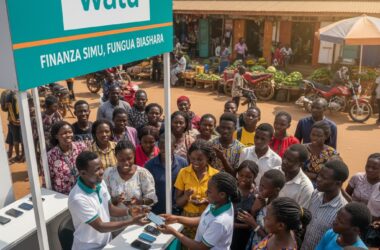





A failed export deal to Europe has quietly become the origin story of one of Zambia’s most talked about agritech startups. It all traces back to two people who first met as teenagers in high school.
Joseph Simukoko and Mwiche Mukoma did not set out to build an artificial intelligence company. First, they set out to sell Zambian food products to the world. In 2022, after years apart building separate careers, the former classmates who had since become husband and wife launched what they intended to be a food export business. She had worked in banking. He had worked in agricultural development. Together, they wanted to take Zambian snacks and flavours global.
That plan hit a wall almost immediately. According to a recent interview with TechCabal, the couple secured what looked like a breakthrough order, a deal to ship plantain products to the Czech Republic. Farmers were lined up. Processors were ready. Even airline logistics and government export support were in place. Then the buyer asked one question that stopped the deal cold. Could every farmer in the supply chain prove compliance with European Union organic standards and provide full traceability?
They could not, and neither could most smallholder farmers across the continent. Large enterprise software providers wanted tens of thousands of dollars for compliance systems built for multinational corporations, not a small Zambian snack business. As Simukoko put it, they were not exporting gold, they were exporting plantain, so the pricing made no sense for a company their size.
Rather than walk away, they turned to a third person, a Zambian software engineer based in the United Kingdom. He had been quietly asking them questions for weeks. Eventually, he sent them a working prototype and simply said to try it. That prototype became the foundation of Giraffe AI. The engineer then joined as a co-founder, taking equity instead of the licensing fees the couple could not afford. What began as a workaround for one blocked export order grew into Green Giraffe, a startup that now uses artificial intelligence and satellite imagery to help smallholder farmers meet compliance standards and connect with premium buyers.
The technology has changed what farming looks like for the people using it. One farmer told Simukoko he used to ask his workers to send him photographs of themselves standing in his maize fields, just so he could judge how the crop was progressing from a distance. Today, that same farmer opens an app and sees the real condition of his farm instantly. He can check whether the crop has been watered and fertilised, and how it compares against expectations. Green Giraffe has also built what the founders call a virtual warehouse. Here, buyers specify the crop variety, quality standard and compliance requirements they need before a single seed is planted. As a result, farmers can grow with a guaranteed buyer already lined up. Sometimes they discover that a crop like cucumbers or soybeans will earn many times more than the maize they have always planted out of habit.
Mukoma and Simukoko trace their partnership back further than the business itself. They met at university roughly two decades ago. She studied finance and he studied agriculture, though their real bond as high school sweethearts had already formed years earlier. That long history shows up in how they describe working together now. For instance, Simukoko has said he only recently admitted that Mukoma is the stronger communicator between them. She connects people to the story behind the business, not just the technical facts. Mukoma, in turn, credits his humility and his habit of asking whether there is a better solution before settling on a decision.
The road to building Green Giraffe was not smooth. The founders finished fifth out of five finalists at their first major pitch competition. Mukoma has described this as one of the most painful moments of the journey, coming just after she left a secure banking career convinced the company would change the world. They did not win funding that day. However, one person in the room kept believing in them and began opening doors that eventually led to other opportunities. That same pitch deck is now reportedly used to train other founders.
SEE ALSO:Jeff Bezos Pushes AI-Driven Overhaul of Amazon Prime Video as Streaming Enters a New Era
Their bigger argument goes beyond their own company. Both founders speak openly about a structural problem in African trade, where it is often easier and cheaper for African countries to export to Europe than to sell to each other. For example, Simukoko has pointed to how colonial-era trade infrastructure still shapes commerce today. That infrastructure was built to move raw materials out of the continent, not to connect African markets to one another. Because of this, he argues that countries should ask how to sell more to neighbours like Ghana, Mauritania or Kenya before defaulting to European markets. Even language reflects the bias, he notes, since landlocked countries are rarely described as land linked instead.
Mukoma has been equally direct about what she believes needs to change at a policy level. She argues that Zambia’s long standing fertiliser subsidy programme has become politically untouchable, despite decades of limited results. That same money, she says, could instead build processing facilities and strengthen local value chains. Meanwhile, Simukoko, who has helped draft parts of Zambia’s Comprehensive Agriculture Trade Programme, says policymakers too often respond to influential lobbyists rather than the smallholder farmers who make up the bulk of the sector.
There is a lot of talk about satellites, artificial intelligence and large language models shaping this industry. Still, both founders insist the technology only works because it starts from what farmers already know, rather than replacing it. Simukoko is blunt about this point. Farmers understand their soil, their pests and their weather better than any outsider ever could. So, the real gap is information about markets, prices and demand, not farming knowledge itself.
Less than three years since launch, the founders say Green Giraffe has already changed how thousands of farmers interact with markets and food systems. They measure this less in valuation and more in one simple question, whether Africa’s difficulty trading with itself is genuinely getting smaller. As Mukoma put it, she will consider herself successful the day Africa trades with itself.