




Google is giving Android users a new way to watch their AI agents work. Users no longer need to babysit an agent inside an app to know what it is doing.
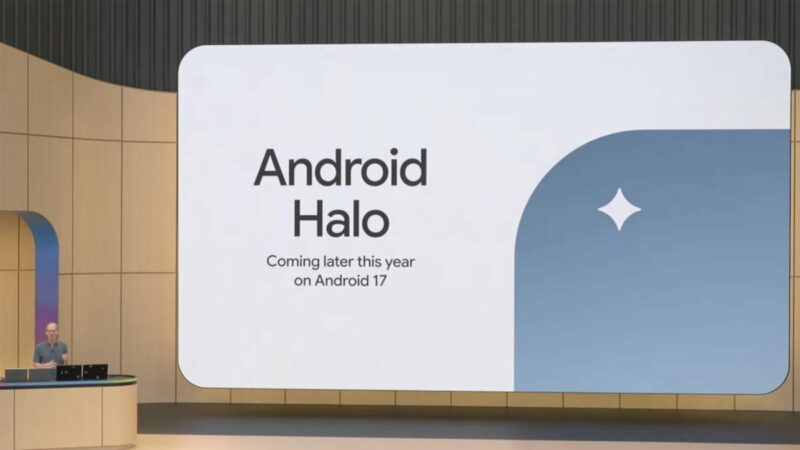
The feature is called Android Halo. Google first previewed it in May at Google I/O 2026, alongside Gemini Spark, its newest proactive AI agent for the Gemini app. At the time, the announcement came with little more than a short teaser clip and a cryptic name. Two months later, however, Android’s leadership has started filling in the gaps. The picture that is emerging is one of the clearest signals yet of how Google wants agentic AI to actually live on a phone.
So how does it work? Android Halo carves out a permanent space in the status bar. That is the strip at the top of the screen that normally shows time, signal, and battery. Whenever an agent such as Gemini Spark runs a task in the background, enters what Google calls live mode, or needs to message the user, a small indicator appears in that space. Tapping it lets a person check progress, answer a quick question, or view a finished result. Importantly, they can do this without switching out of whatever app they were already using.
Sameer Samat, president of the Android Ecosystem at Google, explained the thinking behind the feature. He spoke with Logan Kilpatrick, product lead for Google AI Studio, on the Google Developers YouTube channel. According to Samat, agents working in the background will often need to ask a question, share an update, or show a result. Halo, he said, gives them a consistent place to do that instead of forcing users back into a separate app.
Samat also touched on the technical guardrails behind the feature. He explained that Android is building a kind of virtual window system made specifically for AI agents. As a result, when Gemini or another supported agent takes on a task, it runs inside a contained environment tied to the app the user has designated. That window can then be minimized down into the status bar, which becomes Halo. Notably, Samat added that an agent operating this way cannot break out of its container to access other apps on the device. This detail speaks directly to growing concerns about how much autonomy AI agents should have on personal devices.
That containment matters for a simple reason. Halo is arriving at a moment when regulators and users alike are increasingly uneasy about AI systems acting on a person’s behalf without clear visibility into what they are doing. Google has therefore framed Halo as part of a broader shift in Android’s identity, moving the operating system from a static platform toward what it calls an intelligence system. In this system, a user simply states an intent, and the system handles the surrounding context and actions. On top of this, the feature also ties into upcoming upgrades to Android’s Privacy Dashboard. Those upgrades will let users review recent AI activity, including which apps an agent touched and when it was active.
SEE ALSO:BVAS Runs Android 10, Raising Osun Poll Security Fears
Availability details, meanwhile, are still limited. Google has said Android Halo will ship with Android 17 later this year. Initially, it will work with Gemini Spark before expanding to other supported agents. In addition, the company has mentioned plans for a Halo API. This would let developers connect third party AI agents to the same status bar space, rather than keeping it exclusive to Gemini. On devices equipped with Gemini Intelligence, Google says Halo will unlock additional capabilities, though it has not specified what these are yet. Some reports also point to an early version of the feature debuting alongside the Pixel 11 launch, but Google has not confirmed a firm release date.
For now, Android Halo remains a preview rather than a finished product. Still, it gives concrete shape to a question the whole industry has been circling: as AI agents take on more independent tasks on phones, how does a person actually keep track of what is happening in the background? Google’s answer, at least for Android, is simple. Instead of hiding that activity inside an app, the company is putting it where users already look dozens of times a day, right at the top of the screen.