


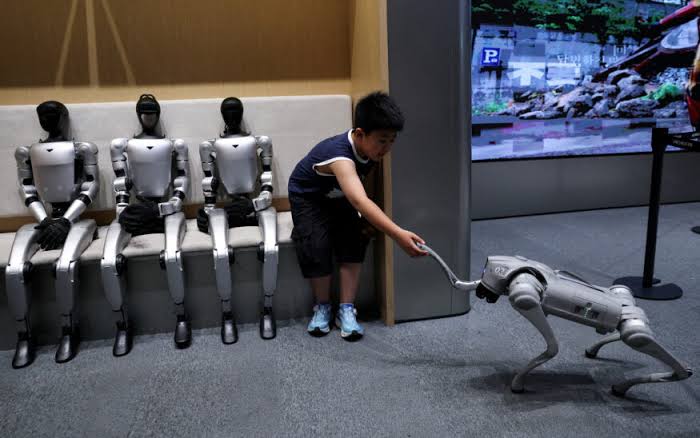
Humanoid robots are becoming something you can rent in China rather than simply watch in viral videos.
Unitree’s humanoid robots are already part of China’s growing robot-rental market. Businesses and event organisers can bring a working humanoid to a venue without buying one outright.
A Unitree G1 typically rents for between 2,500 yuan and 3,500 yuan per day, according to China Daily. The company’s U2 model, designed for dancing and performances, costs around 4,000 yuan per day.
That may sound like an expensive novelty. However, the rental model addresses one of the biggest problems facing humanoid robotics: cost.
Buying a humanoid robot requires a large upfront investment. Many potential customers may also need one only for a product launch, exhibition, livestream or corporate event.
Renting changes that calculation. A business can use a humanoid for a few days without buying, maintaining or storing the machine.
China is building a robot rental market
China is now building infrastructure around that idea.
Shanghai launched what it described as the country’s first open robot-leasing platform in December. The platform uses a Robot-as-a-Service model and lets customers rent different types of robots for specific needs.
Customers can rent basic humanoids for about 3,000 yuan a day. More capable dance models can cost around 5,000 yuan per day.
Other rental platforms are also emerging across China. Companies are offering robots for performances, exhibitions and promotional activities.
Some rentals also come with technicians. Operating a humanoid safely and reliably can still require human assistance.
Unitree is well positioned for this market because its robots are already among China’s most recognisable humanoids.
The company’s G1 and H1 robots have appeared in viral demonstrations involving dancing, running and martial arts. Unitree also supplied H1 humanoids for China’s 2025 Spring Festival Gala, giving the company enormous public exposure.
The rental market is now turning that attention into something more practical.
A company does not need to buy a humanoid to put one on a stage. It can rent one for an event, use it for a demonstration and return it when the job ends.
That could become an important bridge between humanoid robots as entertainment and humanoid robots as commercial tools.
The technology, however, remains far from replacing human workers. Humanoids still face challenges with reliability, endurance and performing complex tasks without human intervention.
But rental changes the equation.
Instead of asking whether a business can afford to buy a humanoid, the question becomes whether it is willing to rent one for a day.
That is a much easier experiment.
China’s emerging robot-rental market suggests humanoids may not need to become cheap enough for everyone to own before they become widely visible.
They may simply need to become cheap enough to rent.