



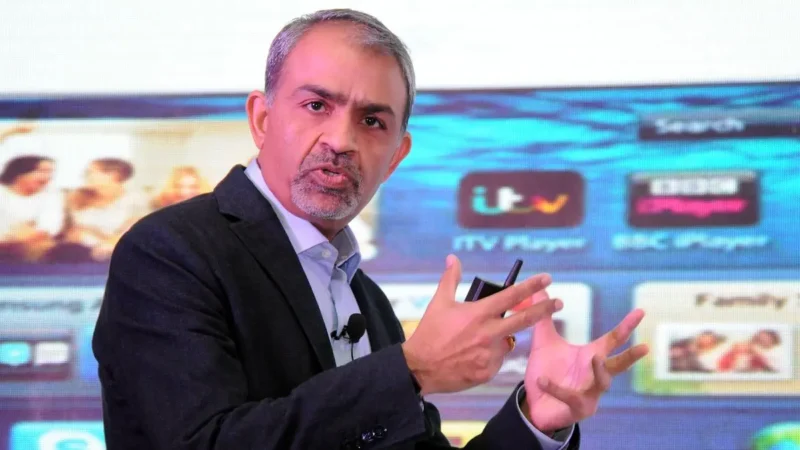
Airtel Africa’s chief executive, Sunil Taldar, wants telecom operators across Africa to share network infrastructure more widely. His goal is simple. Cut costs and speed up connectivity for millions of users.
This push is not just talk. Over the past year, Airtel Africa has signed several infrastructure-sharing deals. Together, they point to a bigger industry shift.
Taldar believes building duplicate networks no longer makes sense. In his view, telecom rivals can still compete fiercely on price and service. But they can also share towers, fibre routes, and base stations behind the scenes. Doing so avoids wasteful spending on parallel networks in the same locations.
CHECK OUT:Nigeria, Ghana power MTN’s historic $7.18bn H1’26 revenue, offsetting South Africa struggles
This approach already has a track record. In March 2025, Airtel Africa signed a landmark deal with MTN Group. The agreement covered infrastructure sharing in Nigeria and Uganda, two of the continent’s biggest telecom markets. Both companies pointed to rising demand for data and mobile money services as the main driver.
By August 2025, Airtel extended the same model to Vodacom Group. That deal covered fibre and tower sharing in Mozambique, Tanzania, and the Democratic Republic of Congo. Taldar called it a business imperative. According to him, collaboration on critical infrastructure builds stronger networks that can support emerging technologies and growing data demand.
The momentum has not slowed down. Airtel Africa and MTN are now in advanced talks to expand infrastructure sharing into Rwanda, Congo-Brazzaville, and Zambia. Industry analysts say shared infrastructure can significantly cut deployment time. As a result, rural communities could get faster and more reliable service months earlier than usual.
Rising costs are adding pressure too. Airtel Africa’s latest results flagged concerns over energy expenses. Many African telecom operators still depend on diesel-powered base stations because grid electricity remains unreliable in several markets. So when fuel prices rise, running duplicate networks becomes harder to justify. That is exactly why Taldar has made cost efficiency one of Airtel Africa’s core strategic priorities, with infrastructure sharing as the main lever to achieve it.
There are wider benefits too. Shared infrastructure could speed up 4G and 5G rollout across underserved parts of Africa. Instead of each operator investing separately in costly upgrades, pooling resources lets them expand faster. This, in turn, could help keep prices more competitive for everyday users.
However, regulators will likely need to stay involved as these partnerships grow. Fair access rules matter. Smaller operators should not be left at a disadvantage, and shared deals must not tip into anti-competitive behavior.
Even so, the direction is clear. What started as a handful of bilateral agreements is now shaping up as a model Airtel Africa’s leadership wants the whole industry to follow. If more operators buy in, millions of people in rural and underserved communities across Africa could soon enjoy faster, cheaper, and more reliable connectivity.