




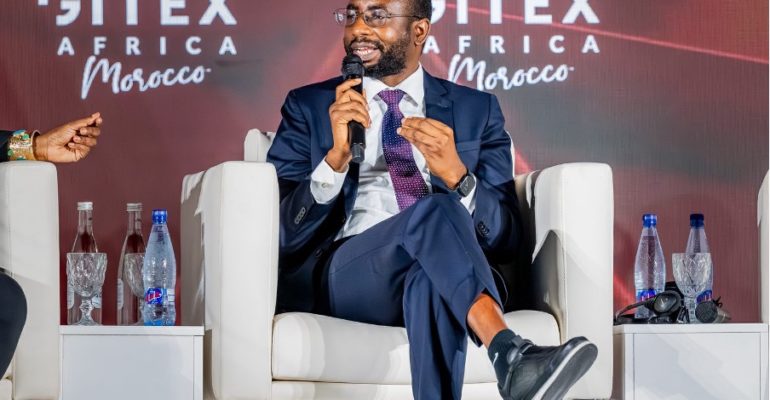
Nigeria’s technology chief has issued a blunt warning. Kashifu Inuwa Abdullahi, Director-General of the National Information Technology Development Agency, says Africa cannot afford to outsource its artificial intelligence and data infrastructure to foreign powers.
Inuwa made the remarks at the GITEX Nigeria: Government Leadership and AI Summit in Abuja. He addressed a room packed with senior government officials, lawmakers, and industry executives. Among them was the Chairman of the Senate Committee on ICT and Cybersecurity, Senator Shuaib Afolabi Salisu.
His message was direct. “We missed the 4th industrial revolution; we mustn’t miss the AI revolution,” he declared. AI, he said, should no longer be treated as a passing tech trend. Instead, leaders must treat it as essential sovereign infrastructure. It can generate intelligence about Nigeria’s economy, security systems, and citizens.
Inuwa also tackled a common misconception about AI bias. He rejected the idea that machine learning models carry bias on their own. Instead, he pointed to the training pipelines behind them. “AI is not biased; it’s the training data that’s biased,” he said. “If we want AI that will serve us, we need to train it with our data.”
DON’T MISS:GITEX Nigeria 2026: All You Need to Know
That call for indigenous data governance received strong backing from the Presidency. A representative delivered the keynote address on behalf of the Secretary to the Government of the Federation, Senator George Akume. The address reinforced the administration’s plan. Nigeria must move from being a market of passive technology consumers to a hub of digital producers.
Beyond data, Inuwa framed sovereignty as something bigger. It spans the entire technology stack. This includes connectivity, computing power, data centres, cloud infrastructure, data governance, and AI models themselves. He noted that Nigeria already has the capacity to build these technologies. So the country needs to invest seriously in connectivity, compute power, and cloud capability.
Officials also stressed one important point. Physical infrastructure and talent alone will not solve the problem. The bigger challenge lies elsewhere. Nigeria must develop indigenous foundational AI models rather than build thin interfaces on top of foreign APIs. Africa is projected to capture a significant share of the global AI economy in the coming years. Because of this, Nigeria’s leadership is betting on owning the full technology stack. That means subsea cables, domestic data centres, and local datasets. This, they argue, is the only path to a self-determined digital future.
The event ties into a broader push. It connects to Nigeria’s National AI Strategy, the 3 Million Technical Talent programme, and Project BRIDGE. The latter aims to deploy roughly 90,000 kilometres of fibre-optic infrastructure across the country. Officials say these efforts will extend broadband access to underserved communities. At the same time, they will strengthen the government’s control over its digital destiny.
For now, Nigeria’s tech leadership appears united on one point. Real digital independence will not come from adopting foreign AI tools. Instead, it will come from building the data, infrastructure, and models to match.