



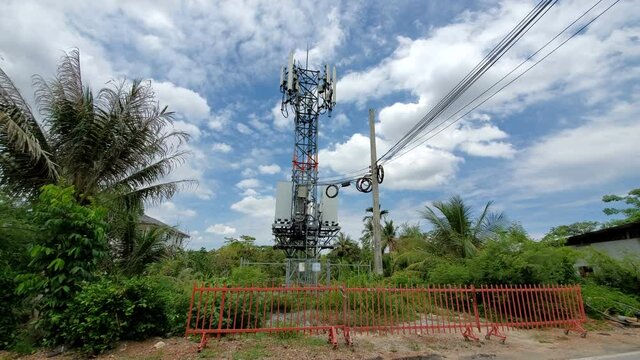
Millions of Nigerians in remote villages continue to live without mobile network coverage, and the reason has little to do with operators refusing to invest in them.
According to a site acquisition specialist who spoke with Technext, the real story behind slow rural tower rollout is a tangle of rising diesel costs, community extortion, and outright hostility from host communities that makes siting new infrastructure in the countryside far riskier than it looks from the outside.
Olayinka Amoo explained that telecom operators weigh population size heavily before choosing where to plant a tower. It sounds simple, but the calculation goes deeper than headcounts. A tiny village in Kaduna with under 200 residents could get connected faster than a larger settlement in Sokoto, all because of hidden variables operators must account for.
In one case Amoo described, a community in Benue got a bigger tower not because of its size but because thousands of worshippers gather there regularly, creating a spike in potential subscribers. Meanwhile, a site near the Borno border was skipped entirely, purely on security grounds.
Money remains the biggest hurdle. Every subscriber added in a rural area costs more to serve than one in the city, and operators are chasing profit margins, not just national reach. A GSMA report from November 2024 found that running a rural base station in Africa costs telecom companies 35 to 40 percent more than an urban one, and in some countries that gap is even wider.
With diesel prices climbing and power supply in most rural areas still unreliable, many operators are effectively running these sites at a loss, so the priority becomes damage control rather than expansion.
Then there is the human factor, which may be the most frustrating part of the whole equation. Amoo detailed how local youths sometimes hold telecom infrastructure hostage over unmet promises made during land acquisition, or simply to extort money from operators.
Fuel delivery trucks get blocked. Maintenance teams get turned away. Disputes over land ownership crop up long after a site has already been secured, with new claimants suddenly emerging to demand compensation. It creates an environment where even operators willing to invest in a community find themselves negotiating with multiple factions just to keep a single tower running.
Some operators are trying to work around the cost side of the problem. Airtel Nigeria said in its 2025/26 annual report that it installed 200 solar-powered towers between April 2025 and March 2026 across rural and urban areas, a move aimed at cutting dependence on diesel.
READ ALSO:Nigeria Fibre Cuts Hit Record 155,000 in Two Months
MTN Nigeria reported similar progress, saying its shift toward gas-powered independent power and inverter systems saved the company 8.5 billion naira in 2025. These are meaningful steps, but they only address one layer of a much bigger problem. Solar panels do not stop a community from demanding unofficial payments, and cheaper power does not resolve land disputes.
The federal government has stepped in with its own ambitions. Minister of Communications, Innovation and Digital Economy Bosun Tijani recently disclosed plans to deliver at least 1,000 new rural towers in 2026, part of a broader plan for 3,700 towers approved by President Bola Tinubu.
The project falls under the World Bank backed Project BRIDGE and is meant to reach some of the more than 20 million Nigerians who currently have no connectivity at all, many of them concentrated in the north, north central, and northwest regions. The rollout is tied to a wider infrastructure push that includes 90,000 kilometres of fibre optic cable and upgrades to Nigeria’s satellite capacity.
Whether government-backed towers will run into the same community friction that private operators have struggled with for years remains to be seen. Diesel costs and terrain issues can be engineered around, but extortion and land disputes are social problems that infrastructure spending alone cannot fix.
For now, the gap between Nigeria’s digital ambitions and the reality on the ground in places like Sokoto and Borno continues to widen, even as billions of naira flow into towers, fibre, and satellite technology meant to close it.