




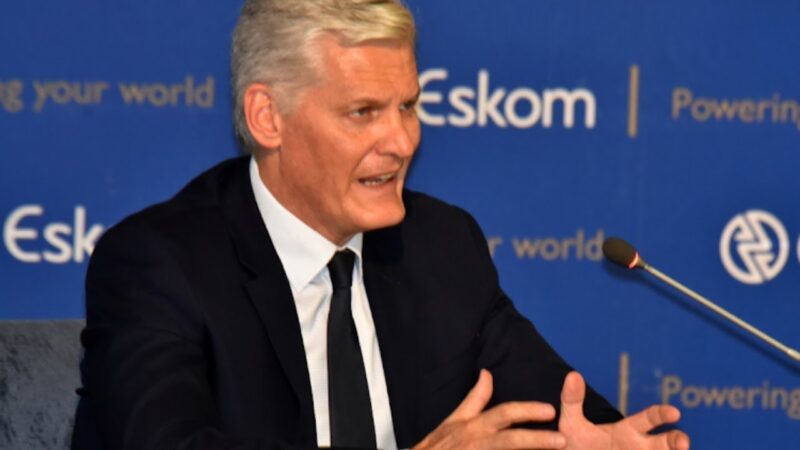
When André de Ruyter left Eskom in early 2023 under dramatic and deeply controversial circumstances, he carried with him a warning that many dismissed as the bitter parting words of a departing executive. He said that if nothing changed, Eskom would eventually be left with a customer base of people who simply cannot afford electricity and therefore do not pay for it. Today, that warning is no longer a prediction. It is a reality unfolding in slow motion, and the numbers are becoming impossible to ignore.
Eskom’s own data shows that week-on-week residual peak demand and contracted peak demand are both down around 8% in 2026 compared to 2025, and this is happening despite the complete absence of load shedding.
That last point is what makes the situation so alarming. South Africans and businesses are not cutting their reliance on Eskom because they have no choice during blackouts. They are doing it deliberately, structurally, and permanently. The lights may be on, but the customers are quietly walking out the door.
READ ALSO:Eskom’s Era Is Fading and DStv’s Cheapest Package Is Getting a Major Shake-Up
Statistics South Africa data shows that seasonally adjusted real electricity generation declined by 6.9% year-on-year in March 2026, a contraction that has persisted since June 2025. Over the first quarter of 2026, electricity generation was 5.6% lower than the same period in 2025. These are not temporary fluctuations. They reflect a fundamental and deepening shift in how South Africa sources and consumes power.
For the twelve months to April 2026, electricity production was 4.7% lower compared to the preceding twelve-month period, and seasonally adjusted real generation fell by 8.7% year-on-year in April 2026 alone. Analysts have been direct about what this means for Eskom’s bottom line. The sustained year-on-year contraction, combined with output levels well below pre-Covid benchmarks, will put significant pressure on the utility’s revenue and does not support single-digit tariff increases going forward.
That pressure on revenue brings us to the core of the trap de Ruyter described. When fewer customers use less electricity, Eskom’s fixed operating costs do not disappear. Eskom itself has acknowledged that lower sales volumes increase pressure on prices due to its high fixed operating costs, meaning that as it sells less electricity, customers can expect higher prices, a trend that has continued for fifteen years.
It is a vicious cycle that feeds itself: higher tariffs push more customers toward alternatives, which reduces revenue, which forces more tariff hikes, which accelerates the exodus.
Eskom implemented an average electricity tariff hike of 8.76% for customers supplied directly by the utility from April 1, 2026, following a Nersa determination. The following year will bring a further increase of 8.83%, as additional funding granted to Eskom is phased in.
Municipalities purchasing electricity in bulk from Eskom are implementing their own adjustments from July 1, 2026, averaging 9.01%. From 2016 to 2026, Eskom electricity tariffs have increased from approximately 86 cents per kilowatt-hour to 234 cents per kilowatt-hour, an increase of about 172%, while general consumer price inflation over the same period totalled approximately 60%.
The corporate response to this pricing spiral has been rapid and increasingly organized. In recent weeks alone, Tiger Brands and the University of Cape Town have both signed wheeling agreements to access privately generated renewable energy through Eskom’s grid, cutting their direct reliance on Eskom-generated electricity.
Tiger Brands signed a wheeling agreement with Apollo Africa, and its manufacturing sites in Ekurhuleni Municipality are expected to receive approximately 60% of their electrical supply from wheeling by 2028. UCT’s agreement with Discovery Green will see between 70% and 90% of the electricity consumption across its main and health sciences campuses converted to renewable energy.
These are not fringe actors or small businesses looking to shave a few thousand rand off their monthly bills. Tiger Brands is South Africa’s largest food producer. The University of Cape Town is one of the country’s most prominent institutions. When entities of this scale begin engineering Eskom out of their energy supply chains, it sends an unmistakable signal about where the rest of corporate South Africa is headed.
De Ruyter, who has since returned to South Africa after periods at Yale University and Oxford, has continued to sound the alarm. He notes that South Africa is currently benefiting from a temporary window of opportunity, warning that Eskom’s own medium-term system adequacy outlook report flags an enhanced risk of load shedding from 2029 onwards as coal-fired power stations are retired. Eskom has formally committed to decommissioning ageing coal stations between 2027 and 2030, including Camden, Komati, and portions of the Hendrina and Grootvlei fleets, creating a supply gap that renewable energy and independent power producers must fill.
De Ruyter has warned that South Africa will face a collapse if government does not take decisive action, and that what the country cannot afford is more prevarication, procrastination, and commissions. Those words carry a particular weight now, given that the data is validating what he warned about years before anyone was willing to fully accept it.
The broader concern is that Eskom’s revenue model was built for a South Africa that had no alternative to the national grid. That South Africa no longer exists. A growing segment of businesses, universities, data centres, and increasingly ordinary homeowners are making rational economic decisions to reduce or eliminate their dependence on a utility whose tariffs rise faster than inflation, whose coal fleet is aging out, and whose structural model appears increasingly unsustainable. The nightmare de Ruyter described is not coming. It is already here.