




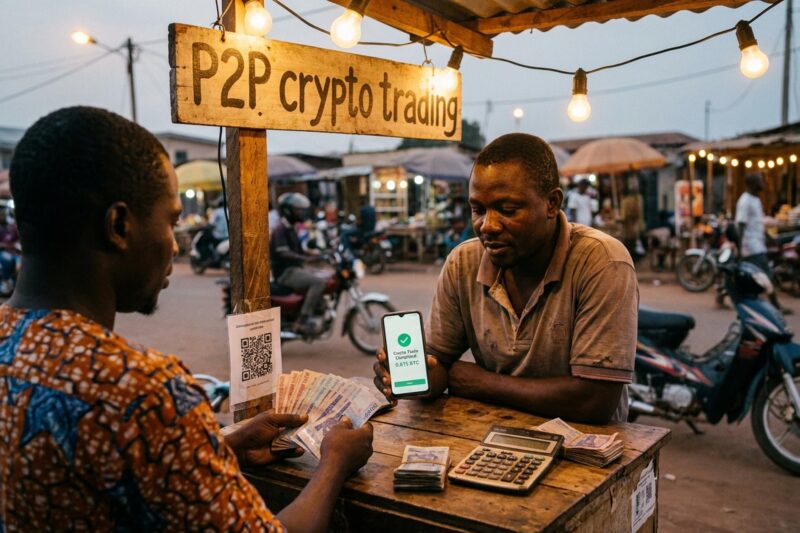
Nigeria has rolled out a new tax framework for virtual assets. Traders who move crypto for a living say the rules could make their business unworkable.
The Nigeria Revenue Service signed the guidelines on July 31. It announced them on August 3. The rules introduce a 1.5% stamp duty on virtual asset transfers, including cryptocurrencies and stablecoins. On top of that, exchanges must deduct withholding tax whenever users dispose of crypto assets. A 7.5% value-added tax also applies to service and transaction fees charged by virtual asset providers. And crypto companies operating in Nigeria still face a 30% company income tax.
For peer-to-peer and over-the-counter traders, the timing matters most. These traders buy and sell crypto in bulk. They survive on razor-thin margins. So the new charges hit at nearly every stage of a deal, when money enters the system, when assets move, and again when they are sold.
Joshua Adedeji is an OTC bulk trader. He says he moves roughly $500,000 worth of USDT weekly on Bybit. According to source reports, he earns about ₦0.5 per USDT on spreads and serves more than 100 customers a week. He said the new tax burden now dwarfs what he used to pay in transfer fees. He expects trading volumes to fall sharply once the rules are enforced. Taxing multiple points in a single transaction, he warned, will hurt P2P activity broadly.
DON’T MISS:Yellow Card Raises $40M to Expand Global Dollar Accounts
Kenny Olawale trades P2P in Lagos on the stablecoin platform Accrue. He described a similar squeeze. His business processes between $2,000 and $10,000 weekly across dozens of customers, many of them new to stablecoins. He said spreads have narrowed to as little as ₦2 to ₦5 per dollar. That leaves almost no room to absorb a 1.5% charge on every leg of a trade. Users generally dislike paying tax twice on money they already own, he added. Some traders, he said, may scale back once the new costs bite.
The framework goes well beyond retail trading. Virtual asset firms will pay VAT on brokerage commissions, withdrawal fees, and even listing fees charged to token issuers, according to source reports. Centralised P2P platforms that hold buyers’ funds in escrow must deduct taxes before releasing money. Marketplaces that do not custody funds still have to keep records and report transactions to the tax authority. Meanwhile, individual traders handling large volumes must declare and remit taxes directly, with penalties attached for non-compliance.
Industry figures argue the approach is unusual compared with other markets. In the United Kingdom, for instance, tax is typically triggered only when a gain is realised. Kenya has taken a different route too, proposing a 10% excise duty on the fees that virtual asset providers charge, according to source reports.
Opeyemi Akinremi co-founded the crypto payments startup Ivorypay and the exchange Duffle. He said the Nigerian model taxes the entire lifecycle of a transaction, not just the profit. To explain, he walked through a hypothetical ₦1 million Bitcoin purchase. A 1.5% stamp duty would cost ₦15,000 on entry alone. Selling the asset the next day at an unchanged price could still trigger close to ₦9,850 in withholding tax. That means a trader could lose money in taxes without ever recording a gain. Once a regulated exchange starts costing traders two to three percent per trade, he warned, rational users will look elsewhere.
That is precisely the risk industry watchers are flagging. Rume Ophi leads programmes and communications at the Virtual Asset Service Provider Association. He said taxation of the sector is inevitable, and even welcome. However, he cautioned that heavy transaction taxes introduced too early could push traders back toward informal channels instead of closer to compliance. He is now pushing for temporary relief or thresholds for smaller operators.
Olayimika Oyebanji is a legal consultant to the House of Representatives committee reviewing cryptocurrency regulation. He called the framework a global anomaly. Taxing every stage of a transaction, he argued, departs from standard tax fairness principles. Nigeria already runs a dual crypto market, he noted, a formal exchange-driven side and a much larger informal network built on WhatsApp groups, Telegram channels, and OTC desks. He predicted that trading will simply retreat further into that shadow economy rather than disappear altogether.
For traders like Adedeji and Olawale, the bigger question remains open. Can a P2P business stay profitable once every transfer, conversion, and sale carries its own tax? Enforcement mechanisms are still described as unclear, even by industry operators. So many traders will be watching closely in the coming weeks to see how strictly the rules get applied.