


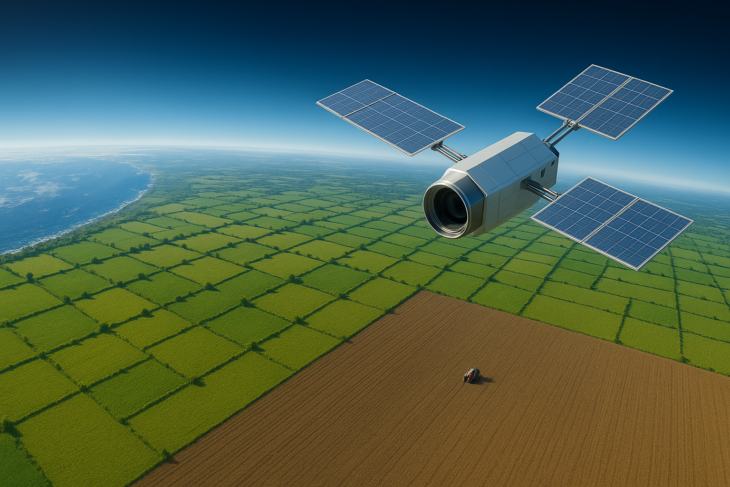
South Africa wants to hit a milestone that has eluded it for decades. The goal is to launch a locally built rocket carrying a satellite into orbit from its own soil by 2030. The institution behind the push says the ambition is real. But the funding and staffing needed to get there are not yet in place.
The effort is led by the University of KwaZulu-Natal’s Aerospace Systems Research Institute, known as ASRI. The institute is developing a liquid-fuelled rocket engine called Saffire, along with a two-stage commercial launch vehicle it is meant to power. Before attempting an orbital flight, though, ASRI first wants to send up a suborbital sounding rocket. That flight is targeted for 2028, according to a TechCentral report published this week.
ASRI’s Professor Glen Snedden was candid about how tightly the timeline depends on money. He said the 2028 suborbital flight hinges on funding and regulatory hurdles being cleared in time. The 2030 orbital target carries the same conditions. Getting a full launch vehicle onto the pad could cost around R3 billion, based on 2023 estimates that Snedden admits need updating. At current exchange rates, that works out to roughly 186 million US dollars. He called the figure modest by international standards.
For now, ASRI is working with far less. The institute has received R100 million from the Department of Science, Technology and Innovation, covering the 2026 and 2027 financial years. Notably, Snedden said everything achieved so far has cost less than that allocation.
READ ABOUT:South Africa Deploys Machine Learning Against Travel Fraud
Money is not the only obstacle. Staffing may be the bigger challenge. ASRI currently has about 20 people on its team. Snedden believes the institute needs to grow to at least 120 staff to hit its targets. That number does not even include jobs likely to be created among suppliers and other supporting industries.
Such rapid growth is hard for a university research institute to absorb. As a result, ASRI is now exploring ways to commercialise parts of its work outside the constraints of UKZN. One step in that direction came in October 2025. ASRI signed an exclusive agreement with local company Mura Space to commercialise the sounding rocket launch facility at the Denel Overberg Test Range near Arniston. Mura has since lined up a pipeline of suborbital campaigns for 2026, some aiming for the Karman line that marks the edge of space. However, those flights involve international teams using ASRI’s launch gantry, not ASRI’s own vehicles.
ASRI is also in early talks with developers of the Cape Winelands Airport about a possible rocket assembly facility. Both sides describe these discussions as preliminary. Meanwhile, the institute’s flagship vehicle, the Phoenix hybrid rocket, has already flown eight times from Overberg. Its altitude record dates back to a 2021 flight that reached 17.9 kilometres, breaking the African hybrid rocket record at the time.
The engine meant to eventually power an orbital launch, Saffire, is designed to produce over 27 kilonewtons of thrust. It has already been tested in a smaller demonstrator form. According to Snedden, the team is now in the early stages of testing its first full scale electric turbopump. He calls this the key to unlocking the entire system once complete.
Beyond the technical work, Snedden pointed to a tougher problem. Launch technology is dual-use and tightly controlled internationally, which complicates any effort to bring in outside expertise or partnerships. Genuine progress, he said, will require credible government-to-government assurances that do not currently exist in full. Shortcuts through technology transfer, he warned, could end up costing more than building the capability from scratch.
So will South Africa meet its 2030 target? That depends on variables well beyond engineering. Can the R3 billion price tag be raised? Can the institute multiply its workforce sixfold in under four years? For a country that has flown satellites before but never launched one from its own territory, the ambition alone marks a shift in how seriously local space capability is now being taken.