


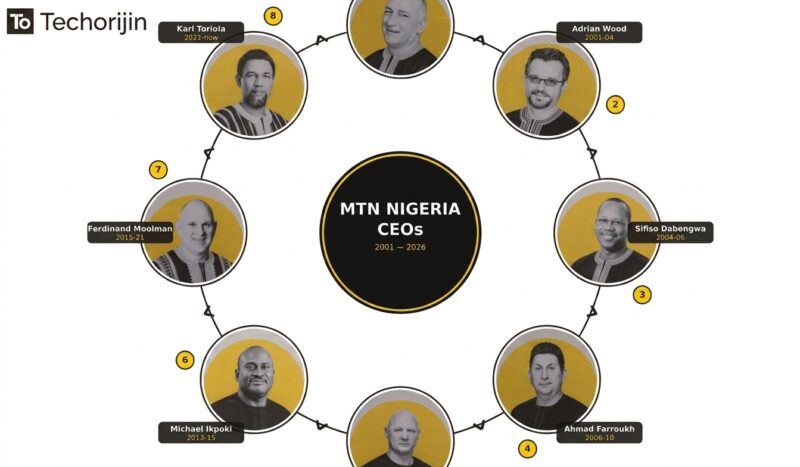
Nigeria’s telecom story cannot be told without MTN. Since 2001, MTN Nigeria has grown into the country’s largest mobile network operator. That growth did not happen by chance.
Instead, it happened because of the leaders who steered the company. They navigated licensing battles, regulatory storms, and currency crises. They also delivered a historic stock market listing.
Over the past 25 years, eight chief executives have run MTN Nigeria. Each one left a distinct mark. Here is a look at who they are and what they built.
Karel Pienaar opened the story. He managed the rapid rollout of Nigeria’s first switching centres and base stations. At the time, Nigeria had very few connected phone lines.
As a result, Pienaar built the foundational infrastructure from scratch. He also helped MTN win the race to make the country’s first commercial GSM call. Later, he moved to a senior role at MTN Group. He retired in 2015 as one of the company’s longest-serving pioneers.
Adrian Wood followed next. Nigerians remember him as the man who secured MTN’s digital mobile licence for 285 million dollars in 2001. He then launched commercial operations that same August.
Under his watch, MTN scaled quickly. The company reached Nigerians who had never owned a phone before. Wood set the early standards for network quality, distribution, and customer care. He also laid the groundwork for per-second billing, a service that would soon transform how Nigerians paid for calls.
Sifiso Dabengwa took over in 2004. He standardised network quality and rolled out per-second billing across the network. This change made airtime more affordable for everyday Nigerians.
Because of this, mobile phones spread quickly across the country. Dabengwa’s strong performance in Nigeria propelled him up the ranks at MTN Group. He eventually became Group President and CEO. However, he stepped down from the Nigerian role in November 2015. That decision followed the company’s landmark five point two billion dollar regulatory fine.
Ahmad Farroukh led MTN Nigeria from 2006 to 2010. This period brought explosive subscriber growth. Under him, the customer base jumped from around nine million to more than 40 million users.
Farroukh also pushed rural telephony and localised pricing. As a result, MTN’s network reached areas that had never had reliable phone access. In addition, he launched the company’s corporate social investment efforts through the MTN Nigeria Foundation. He later rose to become MTN Group’s Chief Operating Executive.
Brett Goschen arrived in 2011 after leading MTN Ghana. His tenure coincided with the early rise of smartphones and data demand across Africa. During this time, he oversaw major subsea cable investments.
For instance, MTN joined the West Africa Cable System. This investment brought down the cost of broadband in Nigeria. Consequently, his work helped set off the country’s modern internet and smartphone boom. He left in 2013 to become MTN Group’s Chief Financial Officer.
Michael Ikpoki made history in July 2013. He became the first indigenous Nigerian to lead MTN Nigeria. His appointment showed growing confidence in local corporate talent.
During his tenure, Ikpoki pushed corporate digital services. He also positioned MTN as a serious partner for enterprise clients. In addition, he worked to strengthen dialogue between the telecom industry and regulators like the Nigerian Communications Commission. He resigned in December 2015, shortly after the NCC imposed its historic 1.04 trillion naira fine over unregistered SIM cards.
Ferdinand Moolman took charge in 2015. He stepped into one of the most difficult moments in the company’s history. First, he guided MTN Nigeria through resolution talks tied to the SIM registration fine.
Then, he steadied the business and rebuilt investor confidence. His biggest achievement came in May 2019. He took MTN Nigeria public on the Nigerian Stock Exchange, now the NGX, through an introductory listing priced at 90 naira per share.
Two years later, the company carried out a retail public offer for 575 million shares at 169 naira each. Investors oversubscribed the offer by more than 139 percent. Moolman also grew the subscriber base past 67 million. In March 2021, he handed over to Karl Toriola and moved into a group-level role as MTN Group’s Chief Risk Officer.
Karl Toriola has led MTN Nigeria since March 2021. Under his leadership, the company expanded 4G coverage and launched Nigeria’s first 5G network. He has also steered the business through currency devaluation and inflation.
SEE ALSO:Airtel Africa CEO Wants Industry-Wide Infrastructure Sharing
Despite these headwinds, Toriola has kept MTN as Nigeria’s largest mobile operator. He also secured a banking licence for MoMo PSB, pushing MTN beyond telecoms into financial technology. Meanwhile, active subscribers have grown past 92 million under his watch.
His strong performance earned him an added role in late 2025. He now serves as Vice President of Francophone Africa, overseeing countries including Cameroon, Côte d’Ivoire, Benin, and Congo-Brazzaville, alongside his existing duties in Nigeria.
From Pienaar’s first switching centres to Toriola’s 5G rollout, each MTN Nigeria CEO answered the demands of a different era. Together, their decisions built the telecom giant that now serves more than 90 million Nigerians.