



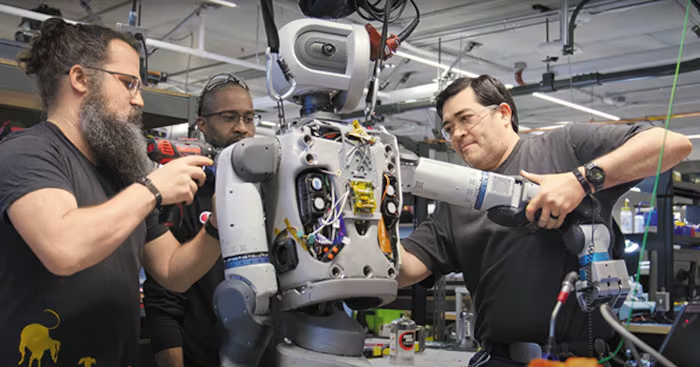
Samsung, Hyundai, SK, and LG are pouring hundreds of billions into AI, robotics, and the data pipelines needed to train the next generation of physical AI systems; positioning Korea as the foundational supplier to the global humanoid robot industry.
South Korea’s biggest industrial corporations are not just building robots. They are building the infrastructure that will train them and the scale of that bet is staggering.
In the late 2025, Samsung, Hyundai Motor Group, SK, and LG announced a coordinated domestic investment wave equivalent to roughly US$480 billion, targeting advanced semiconductors, AI data centers, and robotics. Hyundai Motor Group’s chairman Chung Euisun described the core focus plainly: “fostering Korea’s AI and robotics industries.” More than 70% of Hyundai’s 125.2 trillion won commitment nearly 89 trillion won is earmarked for AI, robotics, autonomous driving, and related R&D.
Robot Data Is the Bottleneck Nobody Is Talking About
The race to commercialize humanoid and industrial robots has exposed a critical missing layer: robot training data. Just as TSMC became indispensable to the chip industry by providing the manufacturing infrastructure every chip designer depends on, the companies building platforms to collect, process, and supply robot training data are emerging as the foundational tier of the physical AI supply chain.
Hyundai has confirmed that its planned AI data centers will specifically process data generated by physical AI robots and autonomous vehicles for model training. In May 2026, LG CNS became the first Korean company to launch a full end-to-end robot training platform, Physical Works, which cuts robot deployment time to one to two months using AI-generated simulation data. Meanwhile, Crowd Works and XYZ Inc. announced a partnership in March 2026 to build and commercialize robot training datasets targeting the physical AI market.
Korea holds a structural advantage few countries can replicate. It leads the world in robot density at 1,012 robots per 10,000 workers. Its precision motor manufacturing, automotive drive unit production, and advanced semiconductor packaging all exist within the same 200-kilometer industrial corridor , solving supply chain coordination problems that cripple robotics startups elsewhere.
Korea’s Structural Edge
Korean companies swept CES 2026, winning 60% of all Innovation Awards and taking eight of fifteen spots in the Robotics category alone. The government is reinforcing corporate investment with a 10.1 trillion won national AI budget for 2026,a doubling of direct AI R&D spending in a single budget cycle. The Ministry of Trade, Industry and Energy has separately allocated 100 billion won by 2030 specifically to build industry-grade datasets for AI factories and robotics systems.
SEE ALSO: Tanzania’s Swahili AI: Speaking the Future Into Existence
Korea is making a deliberate play to own the data infrastructure layer of physical AI the same way Taiwan owns chip fabrication. With one million robots planned for domestic deployment by 2030, the country has a captive data generation engine no startup ecosystem elsewhere currently matches. The chaebols are not just customers of the robotics revolution , they are positioning themselves as its essential backbone.